





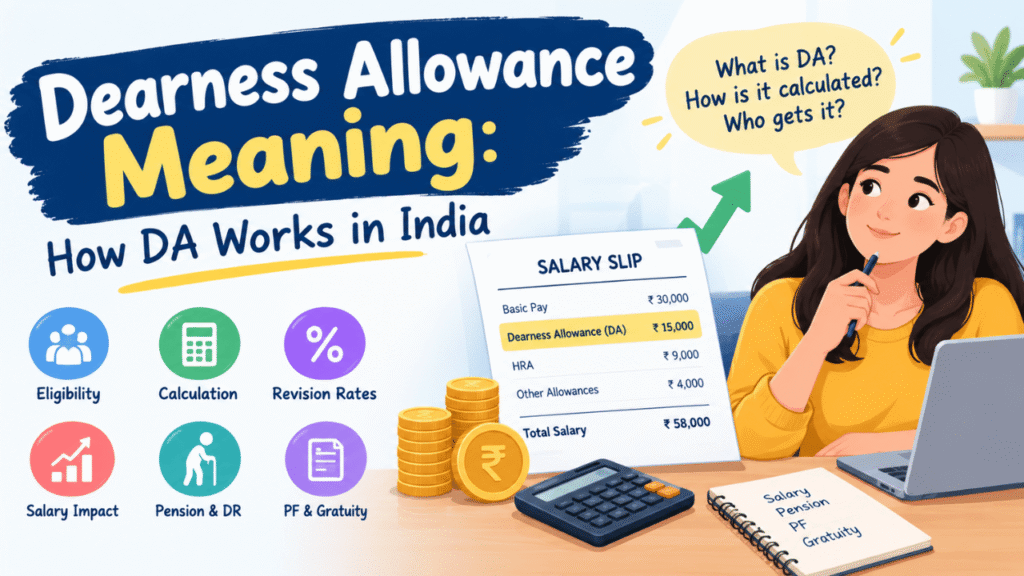
If you’ve ever examined a government salary slip and wondered why the value of one specific line item keeps fluctuating every few months while your basic pay remains be in the same range, then you’ve probably bumped into dearness allowance. Knowledge of dearness allowance meaning is required for an individual working in the public sector, or if you’re a pensioner or just trying to make sense of how Indian government salaries work. Here, we get you to the bottom of what dearness allowance is, how it is calculated, why does it keep changing frequently and how will that affect your net take-home pay.
What Is Dearness Allowance?
So the dearness allowance meaning really boils down to one thing: offsetting inflation in purchasing power. DA, or dearness allowance, is a percentage of basic pay that is fixed for Indian government employees and pensioners, calculated based on official inflation data and serving as a cost-of-living adjustment.
Dearness allowance is intentionally made to move regularly because, unlike basic pay, recommended by every constitutional schedule of a proper pay commission, they mostly remain stagnant between two formal pay commission revisions and hence erodes employees’ real income slowly but surely through increased prices of the most basic needs. And that is indeed the crux of dearness allowance meaning: rather than a bonus or reward for performance, it is an orderly apparatus to align salaries with economic reality.
Recent Dearness Allowance Rate History
Applying some numbers to the meaning of dearness allowance, the prices that rose over recent revisions for central government employees are as follows.
| Effective Date | DA Rate |
| July 2021 | 31% |
| January 2022 | 34% |
| July 2022 | 38% |
| January 2023 | 42% |
| July 2023 | 46% |
| January 2024 | 50% |
| July 2024 | 53% |
| January 2025 | 55% |
| July 2025 | 58% |
| January 2026 | 60% |
Currently, as per the last revision on 1st October, 2023, the existing DA rate is at 60 percent of basic pay (effective from January 1, 2026), after Cabinet approved a hike of two percentage points from the earlier rate of similar wages being paid early at that time till date stand for an increase from 58 percent. Data based on forecasted inflation data shows a further increase up to about 63 percent starting July 2026, but this remains an estimate until formally confirmed.
Who Receives Dearness Allowance?
The dearness allowance meaning is not just about what it entails; it’s also about who it applies to. The primary recipients of DA in India are:
- Central government employees
- Government employees within the state (varies by state)
- Public sector undertaking employees
- Pensioners, meanwhile, are given another payment called Dearness Relief (DR)
Private sector workers typically do not receive a structured dearness allowance, but some private firms have included similar cost-of-living adjustments as part of their respective pay structures, even if they avoid using the term directly on payslips.
Also Read: Gross Salary Meaning | Conveyance Allowance Meaning | Full Form of CTC
How Is Dearness Allowance Calculated?
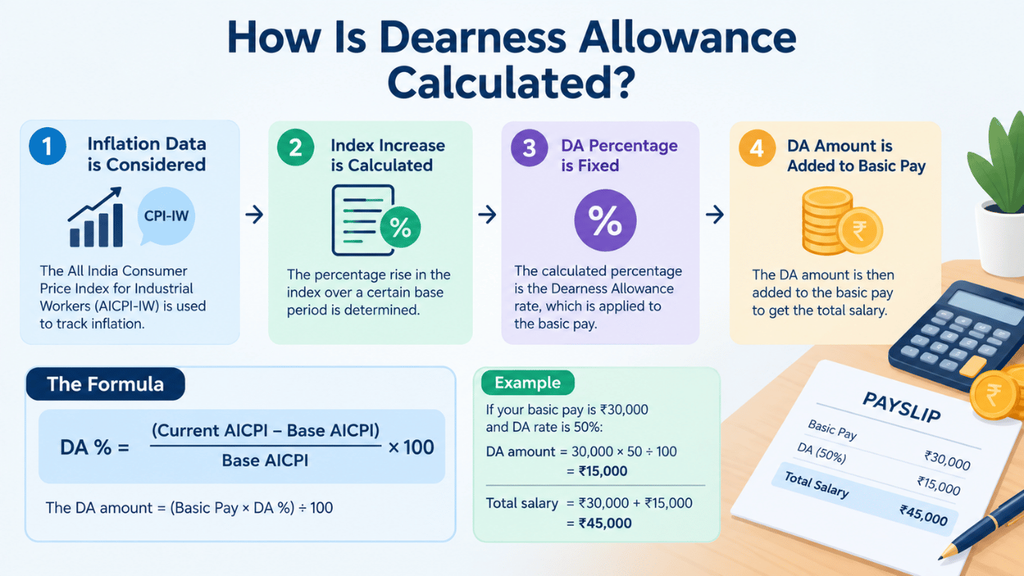
Dearness allowance meaning calculative The calculation for dearness allowance meaning is not arbitrary. The monthly Retail Inflation Rate is the basis for determining DA by using the All India Consumer Price Index for Industrial Workers (AICPI-IW) released regularly by the Labour Bureau, as it applies to central government employees. The formula basically monitors the percentage rise in this index over a certain base period and then translates it into a certain percentage of basic pay.
This DA percentage is calculated and then given at all levels of individuals across eligible employees, with higher basic pay receiving a larger amount of DA than those who have lower basic pay, even though the same number of vaue percent will be given.
Dearness Allowance Calculation Examples
One simple way to understand dearness allowance is to see how much of a DA rate impacts the total payable amount when added to basic pay. The below examples depict the value of DA when either the basic salary or the percentage of DA increases.
| Basic Pay | DA Rate | DA Amount | Basic + DA |
| ₹25,000 | 50% | ₹12,500 | ₹37,500 |
| ₹30,000 | 50% | ₹15,000 | ₹45,000 |
| ₹40,000 | 55% | ₹22,000 | ₹62,000 |
| ₹50,000 | 58% | ₹29,000 | ₹79,000 |
| ₹50,000 | 60% | ₹30,000 | ₹80,000 |
What is the frequency of changing Dearness Allowance?
One of the most basic factors behind dearness allowance meaning is its revision frequency. The central government revises DA every half year by taking the most recent CPI-IW numbers available on home and use weighting of 2001 used for cooking purposes (CPI) index as the basis for how much it will increase, which is then frozen to apply from January 1 and July 1. They are generally announced a couple of months after the effective date, with any pending dues being repaid in arrears to the employees once the order is notified.
Importance of Dearness Allowance Beyond the Monthly Salary
The answer to the question: What does dearness allowance mean is not only about the amount which gets credited to your bank account every month. DA also plays a role in calculating various pension and benefit-related figures, such as:
- Provident Fund contributions (PF is often computed on basic pay plus DA rather than just basic)
- Calculation of gratuity only for basic pay and DA figure at the time of retirement
- Calculations of pensions where Dearness Relief is still being paid to pensioners on the same rate structure as serving employees
- Increased overall tax liability, as a greater DA increases total taxable earnings in the year
And this is also a reason why knowing what is called dearness allowance and understanding of its meaning is important even for those people who do not follow their monthly payslip so closely; there are several other long-term financial calculations related to government employment that would be affected by the situation at hand.
State-Level Variations
The dearness allowance meaning remains unchanged at the rudimentary level, although actual rates vary between the central and state governments. While some states keep their DA rates in line with the dates fixed by the Union Government Schedule, other states will either revise their rates at a different time or use percentages very close to UPSC, DA based upon their budgets and state cost-of-living data. Those Employees working under a state government payroll are recommended to read their respective state notification carefully and not rely on automatically getting the central government rates.
Impact of Dearness Allowance on your Salary
To understand dearness allowance meaning, in practical context, it is helpful to see how it appears on a real pay slip. Take, for example, an employee who has a salary of ₹50,000 as the basic.
| Component | Amount at 58% DA | Amount at 60% DA |
| Basic Pay | ₹50,000 | ₹50,000 |
| Dearness Allowance | ₹29,000 | ₹30,000 |
| Basic + DA Total | ₹79,000 | ₹80,000 |
There are, of course, some housekeeping details to be taken care of; Even a slight percentage increase in DA means a real difference over the month when extrapolated over basic pay and therefore each half-yearly revision is much awaited by government employees and pensioners alike.
Dearness Allowance vs Dearness Relief
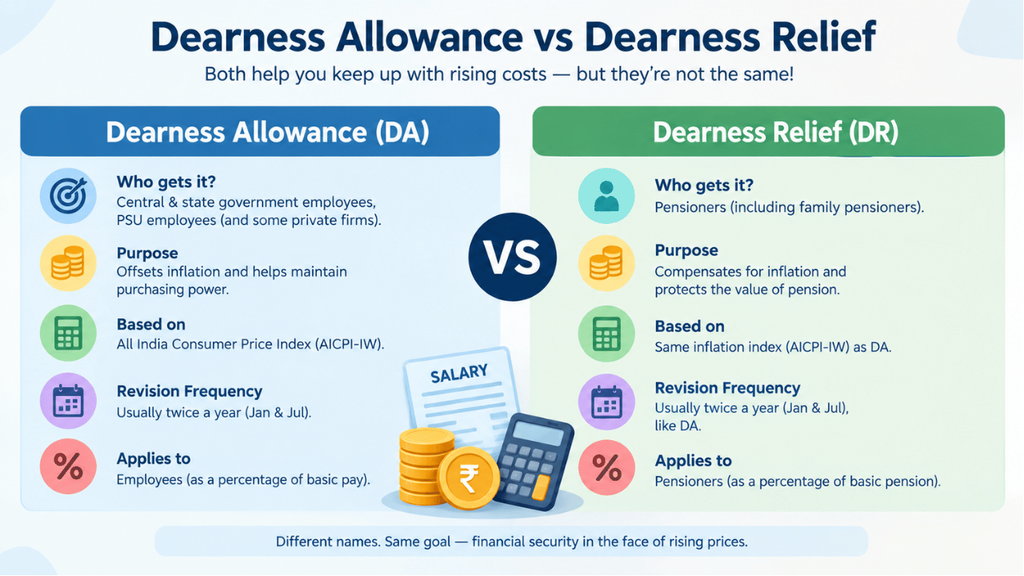
One of the common confusions in understanding dearness allowance meaning is switching between Dearness Allowance and Dearness Relief, where DA applies to employees in service and DR to pensioners. Both are based on the same rate, and both are adjusted semi-annually so that retirees effectively receive the same relative safeguards against inflation as those still working. It’s just the terminology used; the computation mechanism is no different except for whether you are a contractor or employed.
The History Behind Dearness Allowance
In order to appreciate dearness allowance meaning largely, it is important that we also understand where the term originated. The previous four decades in India have seen a series of Pay Commissions that have progressively modified the internal coherence and clash among basic pay, allowances and DA. Each Pay Commission, usually once in a decade or so, normally assumes all accumulated DA into basic pay as at that stage and makes the DA percentage zero to start with before starting its biannual revision cycle that will start building it back up again from this base.
This cyclic repeat of DA increases over the course of a decade, where it gets absorbed by an adjusted basic pay scale, is a hallmark of Indian government compensation management across generations. The longer historical arc, in fact, proves useful to understanding the dearness allowance meaning, more than just the percentage too (and why DA percentages can appear surprisingly high in the run-up to an implementation of a new Pay Commission).
Common Misconceptions About Dearness Allowance
Few misunderstandings recur when people first come across dearness allowance meaning. They mistake DA as a discretionary bonus that management can decide not to provide, when in actuality it is fixed, formulaic calculations depending on published inflation (which leaves little discretionary room). Some others mistakenly conflate a 100% DA percentage with an equivalent increase in the conventional sense; it is better thought of as keeping purchasing power as close as possible to stable than actually raising real income. Understanding the development-related aspects is key to having a better understanding of dearness allowance meaning rather than just tracking the headline percentage every time there is a change in DA.
Also Read: NSG Full Form | SDM Full Form | PCS Full Form | IPS Full Form
Conclusion
Essentially, Dearness allowance meaning comes down to a simple concept – safeguarding the real value of government wages and pensions from the persistent impact of inflation. It is a significant component of take-home pay, pension, and financial planning for millions of central and state government employees and pensioners across India, with the current DA rate at 60% since January 2026, which will be hiked further on in the year. For anyone who relies on this system for his or her livelihood, it is certainly worth spending the time to keep a record of each biannual revision (and also its place in the grander scheme).
FAQs About Dearness Allowance Meaning
1. When is dearness allowance revised?
DA for central government employees is generally revised on January 1 and July 1, two times a year.
2. What is the difference between Dearness Allowance and Dearness Relief?
DA applies to existing employees, while Dearness Relief (DR) applies to retired personnel.
3. Is Dearness Allowance included in Provident Fund & Gratuity?
Yes, DA impacts the calculation of PF, gratuity, and pension benefits.
4. Is dearness allowance the same for all states in India?
No. State governments decide the DA rates and revision schedules independently of the Central Govt.
5. Can we get DA in a private job?
Generally, no. But some private companies are known to provide cost-of-living adjustments under other names.