





As a salaried employee in India, you must be aware of the meaning of conveyance allowance when analysing salary slips, tax deductions and take-home pay. In fact, this is one component that employees see in their cost to company (CTC) but are usually unaware of the role it plays, how it is taxed and what its advantages are. To put it simply, conveyance allowance is an assistance given to the employee by his/ her employer for paying travel-related expenses that he/she incurs during work.
With inaccessible means of transportation and official travel, the conveyance allowance meaning has become even more relevant in a professional scenario today. It assists workers in offsetting transportation expenses but also serves to assist with tax strategy. This comprehensive guide details conveyance allowance meaning, calculation and tax exemptions for conveyance allowance, along with differences between transport allowance and how this component affects your salary structure.
What Is Conveyance Allowance Meaning?
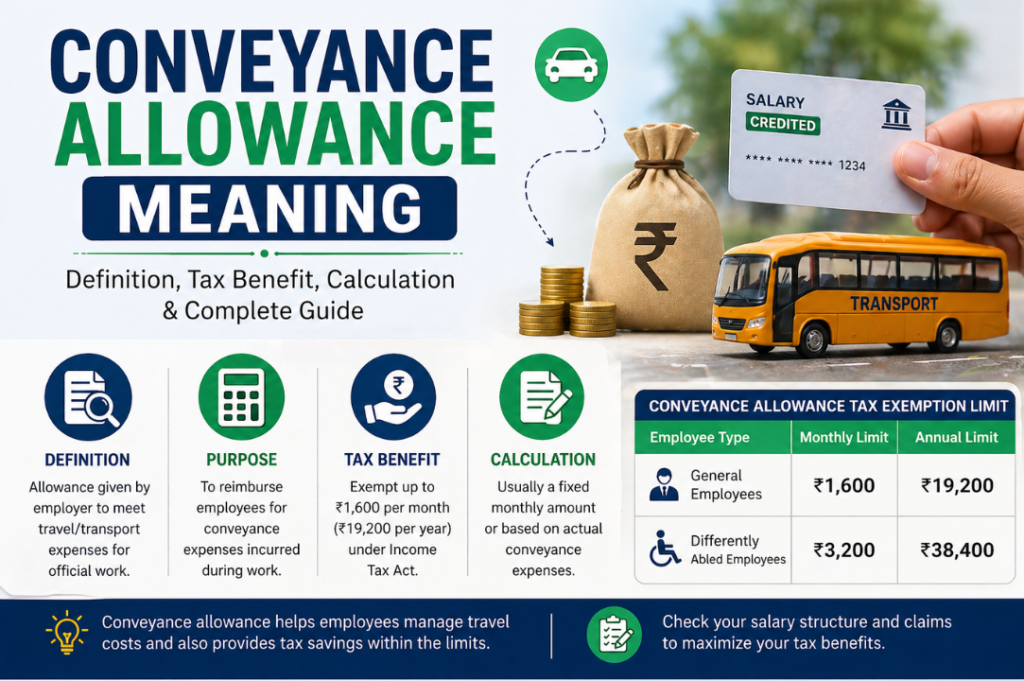
Conveyance allowance meaning: it is an allowance given by the employer to the employee for travelling to work. It covers expenses like petrol, public transport fares, taxi charges and other commuting-related costs that enable you to get to work. To put it simply, the conveyance allowance meaning can be derived as:
Compensation for travel expenses paid by the employer to the employee for performing their work duties. This allowance is commonly displayed as part of the salary structure apart from the basic salary. It is often included in many jobs against private & also government jobs.
Why Conveyance Allowance Is Important
The meaning of conveyance allowance goes beyond being a salary component; it’s effective in lowering the daily financial stress of employees. In metro cities, employees usually invest a lot of their earnings into commuting.
Also Read: MTS Full Form | PCS Full Form
What are the key points about conveyance allowance?
- Helps cover daily travel expenses
- Reduces out-of-pocket commuting costs
- Improves overall salary structure
- Provides partial tax benefits
- Promote the mobility of employees for business functions
Companies add this allowance because they want employees to be able to do their jobs without stressing about transportation-related costs.
Types of Conveyance Allowance
In order to better facilitate the understanding of conveyance allowance meaning.
Official Duty Travel Allowance
This category includes travelling costs associated with any office work, such as going to client meetings or meeting in another part of the city for official requirements.
Daily Commuting Allowance
Many companies offer this allowance either to include the cost of covering daily travel between home and office or to use their own vehicles in case no transport facility is provided.
Fixed Conveyance Allowance
Most companies give a certain amount monthly, which is part of the salary.
Reimbursement-Based Allowance
Some companies have employees submit bills, and the actual travel expenses are reimbursed by the company.
Conveyance Allowance Overview
| Component | Details |
| Purpose | Cover travel expenses |
| Paid By | Employer |
| Included In | Salary structure |
| Type | Fixed or reimbursement |
| Tax Benefit | Partial exemption |
The table below provides a concise overview of the conveyance allowance definition and its salient characteristics.
How Conveyance Allowance Is Calculated
Conveyance Allowance Meaning also means knowing how you calculate that. It is offered in most of the private companies as a fixed monthly salary agreed upon at the time of hiring.
The conveyance allowance is not restricted by any definite legal cap. But the companies generally keep it lower than most big components like basic salary or HRA.
For government employees, the allowance may differ based on:
- Distance traveled
- Mode of transport
- Nature of duty
In contrast, for private employees, typically a standard fixed amount is received.
Conveyance Allowance Exemption Limit
The tax exemption nature is one of the prominent parts of the meaning of conveyance allowance. This allowance is exempt from income tax, as per the Income Tax Act for employees.
Standard Exemption Limit:
- ₹1,600 per month
- ₹19,200 per year
For differently-abled employees:
- ₹3,200 per month exemption
Therefore, if your conveyance allowance does not exceed this limit, it is likely that you will not be taxed.
Is Conveyance Allowance Taxable?
Of course, the definition of conveyance allowance also extends to its taxability. It is not completely tax-free, but you get some benefits.
- All the taxable items if an exemption does not apply
- Substantial only to a specified amount or actual creditors
- An addition to be paid as income tax
For example, if you are getting income of ₹50K a year but end up travelling for ₹30K:
- ₹30,000 – exempt
- ₹20,000 – taxable
As a result, tax benefits are based on actual use and capped.
Conveyance Allowance vs Transport Allowance
We often confuse the two, but they are clearly different.
| Feature | Conveyance Allowance | Transport Allowance |
| Purpose | Official duty travel | Home-to-office commute |
| Tax Benefit | Partial exemption | Mostly taxable |
| Usage | Work-related travel | Daily commuting |
| Flexibility | More flexible | Fixed usage |
Conveyance allowance is also more work-related, while transport allowance relates well to daily commuting.
When is Conveyance Allowance not paid?
There are times when this allowance is not received by employees:
- The company provides a transport facility
- Work-from-home roles
- Remote or non-travel jobs
- Freelancers or self-employed individuals
It can be included for employees who do not incur travel costs.
Advantages of Conveyance Allowance
The conveyance allowance meaning is also related to its benefits.
Key Advantages:
- Reduces commuting costs
- Provides tax savings
- Improves employee satisfaction
- Supports work-related travel
- Adds flexibility to salary structure
It is a smart and easygoing element in today’s salary packages.
Limitations of Conveyance Allowance
Though it has its advantages, the conveyance allowance itself is also accompanied by some restrictions:
- Limited tax exemption
- Not applicable to all employees
- Requires proof in some cases
- Fully taxable beyond limits
- May not be enough to compensate for actual travel expenses in metro cities
Employees should plan finances accordingly.
Real-Life Example of Conveyance Allowance
Now, let us grasp the meaning of conveyance allowance through a straightforward example.
An employee receives:
- Transport Allowance = ₹2,000 per month
- Annual = ₹24,000
Tax exemption:
- ₹1,600 × 12 = ₹19,200 exempt
- Remaining ₹4,800 taxable
Part of the allowance reduces tax, but the rest does not.
How Conveyance Allowance Decreases Salary Structure
And in salary structuring, conveyance allowance meaning is also considered. It is added by the employer for tax benefits and a better take-home salary.
A sample salary structure can look like:
- Basic salary
- HRA
- Conveyance allowance
- Special allowance
- Bonuses
Employers lower taxable income, within legal limits, by providing conveyance allowance.
Also Read: Full Form of CTC | Pilot Salary in India
Conveyance Allowance in India: Future
With the shift of work patterns like hybrid jobs and remote working, the meaning of conveyance allowance is also changing. Corporate organisations are now realigning salary structures to fit with the work models.
Trends include:
- Shift towards flexible allowances
- Integration with reimbursement systems
- Reduced importance in remote roles
- Increased importance in field jobs
Conveyance allowance, however, remains an integral part of payroll systems even with these changes.
Conclusion
The conveyance allowance meaning is the amount that an employer pays their employee so they can travel for work purposes. It forms a critical part of CTC and minimises travel cost to work and provides some tax benefits in the form of HRA.
Most employees have a cap of ₹1,600 per month for this exemption; nonetheless, it is still useful to keep expenses and taxable income down. With an idea of the meaning of conveyance allowance, getting an insight into the payslips is easier for any employee, helps in tax planning and effective money management.
Frequently Asked Questions (FAQs)
Q1) What does Conveyance Allowance mean in salary?
It is a benefit provided by employers to help pay for work-related travel expenses.
Q2) Is conveyance allowance taxable?
Yes, but it is partially exempt up to a limit of ₹1,600 per month.
Q3) Who can claim conveyance allowance?
Employees who have to travel for work.
Q4) Conveyance allowance exemption limit?
₹1,600 p.m / ₹19,200 pa.
Q5) What is the status of conveyance allowance in the new tax regime?
It will depend on the type of allowance claimed and the conditions.