







Each year, many thousands of applicants to the Central Industrial Security Force have one common inquiry: What is the actual pay of the position? The CISF salary is based on the 7th Central Pay Commission (CPC) pay scale, so the applicant can predict their basic pay. However, the applicant’s final take-home salary will be determined by allowances, deductions, and location of employment. The following guide provides information regarding the CISF Full Form, Rank-Wise Pay Structure, CISF Salary Per Month for Constable and Officer Positions, and why the figures provided online seldom align.
CISF Full Form and What the Force Does
The full name of the CISF is the Central Industrial Security Force. This is a central armed police force of India that falls within the jurisdiction of the Ministry of Home Affairs. Established in 1969, the CISF has gained recognition for providing security at major public transportation hubs such as airports and metro systems, along with other sensitive installations such as nuclear and space facilities, ports, and other large public sector enterprises. Additionally, the CISF operates fire services at several of these sites; hence the reason why the CISF recruits both general duty constables and fire constables.
Knowledge of the CISF full form is beneficial while reading recruitment notifications, as the same payment scheme is applicable across multiple trades. Constable (GD), Constable (Tradesman) and Constable (Fire) are on the same pay scale; hence, the initial CISF salary remains consistent irrespective of the trade in which you have been employed.
CISF Salary Structure Under the 7th Pay Commission
CISF pay scales are determined through the use of the pay matrix. The pay scale for each rank is identified by its number on the pay scale. The pay scale is composed of a minimum salary (basic pay) and a maximum salary (scale) that is increased each year. For example, Constables begin their careers at Pay Level 3, which has a minimum salary of ₹21,700 per year and a maximum salary of ₹69,100 per year.
| Rank | Pay Level | Starting Basic Pay |
| Constable / Tradesman | Level 3 | ₹21,700 |
| Head Constable | Level 4 | ₹25,500 |
| Assistant Sub-Inspector | Level 5 | ₹29,200 |
| Sub-Inspector | Level 6 | ₹35,400 |
In accordance with the published salary charts, the Director General (at the peak of the Force) receives an unvarying base salary of Rs. 2.25 lakhs per month. While those high-level employees may not be as important to applicants, they demonstrate how far the CISF’s salary range can go during the course of one’s entire professional life.
CISF Salary Per Month for a Constable
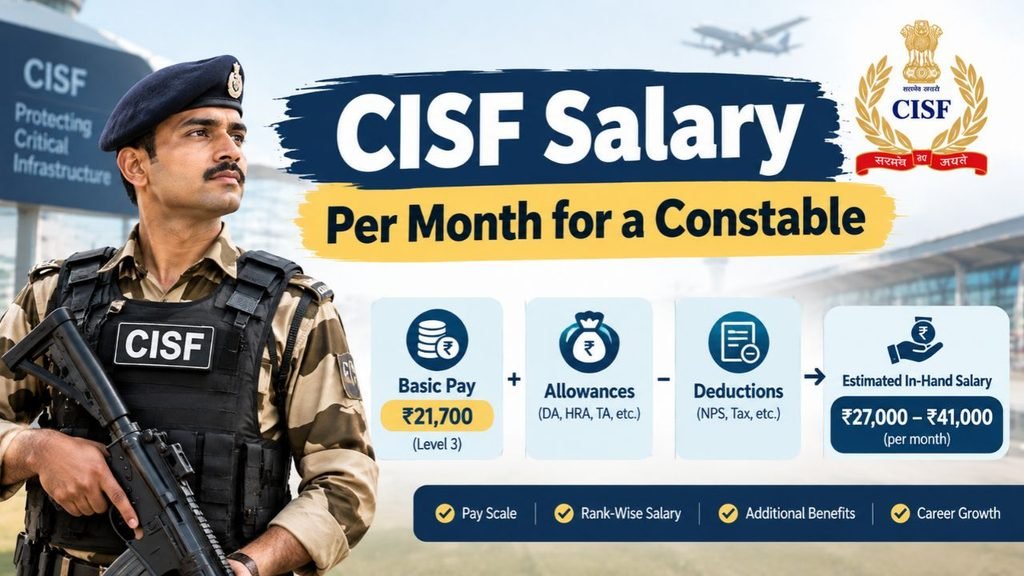
The base pay does not represent the entire picture. The actual amount of money that goes into each constable’s account on a monthly basis, including Dearness Allowance, House Rent Allowance, Ration Money Allowance, and Transport Allowance, less any applicable deductions (like NPS contribution) represents the CISF salary per month.
Sources are divided as to the ultimate in-hand salary. A number of salary guides indicate that a newly appointed constable will receive an in-hand salary of approximately ₹35,000 to ₹41,000 per month. On the other hand, several other guides state that a new constable’s in-hand salary would be in the range of ₹27,000 to ₹32,000. Additionally, one breakdown which was based upon a lower Dearness Allowance rate resulted in an in-hand salary of approximately ₹42,000. Each of these variations exists due to the DA rate that was applied, the classification of the city where the constable is employed, and the types of allowances that were taken into consideration.
| Source Type | Reported In-Hand Pay (Constable) |
| Guides using higher DA and full allowances | ₹35,000 – ₹41,000 |
| Guides with conservative estimates | ₹27,000 – ₹32,000 |
| Older breakdown using 53% DA | About ₹42,000 |
| Wider range quoted by one guide | ₹27,000 – ₹40,000 |
The honest take away is that the CISF salary of a new constable can be best described as a range, with the high ₹30,000s being a common figure in recent guides, but the official salary slip as the final authority.
Also Read: SRPF Salary | COBRA Commando Salary | SSB Salary Per Month | Army Clerk Salary
An Illustrative Constable Salary Breakdown
It is helpful to view an example of how the money is generated. The following breakdown was created using a published salary calculator which utilized a 53% DA rate. As the DA rate has increased since this was published, consider this breakdown as being illustrative of the structure, but do not rely on it for the most current figures.
| Component | Approximate Monthly Amount |
| Basic Pay | ₹21,700 |
| Dearness Allowance (53%) | ₹11,501 |
| House Rent Allowance | ₹2,170 |
| Ration Money Allowance | ₹4,283 |
| Transport Allowance | ₹5,508 |
| Other allowances | About ₹556 |
| NPS deduction (10% of basic + DA) | Around ₹3,320 |
In this instance, that amount of money had a gross total of approximately ₹45,700 prior to any deductions. This illustrates why the average CISF monthly income is significantly higher than just the base pay, since allowances approximately double that number.
How Posting Location Changes CISF Salary
The amount of House Rent Allowance that can be received by employees of the Central Industrial Security Force (CISF) is determined by the class of the city in which they are employed. As such, a constable working within a metropolitan area will generally have a greater take-home pay than a constable working in either a small or remote area. A guide to CISF salaries estimates that a constable stationed in a metropolitan area would typically earn approximately ₹35,000 to ₹41,000 per month, while a constable stationed in a non-metropolitan area would typically earn approximately ₹32,000 to ₹37,000 per month.
Additionally, a guide to CISF salaries provides salary information based on the type of unit in which the constable is employed. This guide indicates that constables working at airports typically earn more money than constables working in industrial or remote areas. Regardless of the specific salary amounts provided in these guides, the general trend is that location affects CISF salary by several thousand rupees per month.
Rank-Wise In-Hand Estimates
Pay levels, responsibilities, and benefits increase with higher ranks, which means that the employee’s net income will also increase. The estimated amounts below represent the combined average of several recent salary guides. Each guide makes its own assumptions.
| Rank | Approximate In-Hand Range |
| Constable | ₹35,000 – ₹41,000 (some guides ₹27,000 – ₹32,000) |
| Head Constable | ₹32,000 – ₹50,000 depending on source |
| Sub-Inspector | About ₹52,000 – ₹60,000 per one guide |
| Assistant Commandant | About ₹80,000 – ₹98,000 per one guide |
Since the head constable salary range alone is between ₹32,000 and ₹50,000 across multiple sources, you need to understand that these numbers are only ranges. Therefore, they will be helpful in your financial planning, but not as accurate indicators of what your actual paycheck will be.
Allowances That Add to CISF Salary
The main ones are the allowances, which transform a modest base salary into a competitive monthly compensation plan.
| Allowance | Purpose |
| Dearness Allowance (DA) | Adjusts pay for inflation; revised periodically |
| House Rent Allowance (HRA) | Housing cost support; depends on city class |
| Ration Money Allowance (RMA) | Food support for force personnel |
| Transport Allowance | Commuting support |
| Risk or special allowances | Added for certain duties and postings |
The DA (Dearness Allowance) must be noted separately because the amount of this allowance is subject to change throughout the year. As such, any CISF salary data that does not indicate the DA rate applied when the data was compiled will become inaccurate over time. This is a primary reason why some published CISF salary estimates differ from each other.
Why Online Figures Differ
Comparing 3 to 4 guides to find a consistency in the DA rate, city classification, inclusion of training period pay, and number of allowances can lead to confusion. This is common due to differences between sources in these areas. Also, some of the information found online may be several months or even years old and use out-of-date DA rates. For any critical decisions regarding your job, depend upon the official recruitment notification and the official pay matrix instead of relying on an individual’s estimated values.
Benefits Beyond the Monthly Paycheck

The CISF salary isn’t the only reason why individuals seek employment there. This job offers a lifetime Central Government position which has a retirement pension plan under the National Pension System; medical insurance; vacation time off, and an established career progression that takes an individual through Constable, Head Constable, Assistant Sub-Inspector, and Sub-Inspector. In addition to these benefits, housing and canteen privileges are available to employees in most force units. While it is difficult to determine the exact value of these benefits, they do provide a form of financial stability, particularly when compared to positions in private security where there is little to no long-term security.
How to Estimate Your Own CISF Salary Per Month
The budget process will require you to create your own cost estimate based on four distinct steps. First, determine the amount of money you make each month at your rank level using the information contained within the pay matrix. Second, use the current dearness allowance (DA) rates established for all central government workers; this allows you to determine how much DA you are eligible to receive.
DA is calculated as a percentage of the base salary of an individual worker. Third, find out if you are entitled to house rent allowance (HRA) based upon the location where you believe you will be stationed. Fourth, calculate the total amount of ration and transportation allowances that are provided for workers in your position. Lastly, take the sum total of these items and deduct the amount of money that goes towards funding your pension, along with any other minor fixed expenses.
There are several benefits to calculating your own sum. The first is that you can see which allowances are most important to you. Second, calculating your own sum will help protect you from relying on a blog that has used an outdated DA rate. After you have received your first official salary slip, check each line against your estimated sum. Your first official salary slip is the only number that matters.
Planning Your Finances on a CISF Salary
The ability to plan for your budget is easier when you have a predictable income, and you are assured that you will be able to remain employed with the company for an extended period of time. There are many recruits who send home a portion of their earnings; therefore, establishing a set amount each month as savings will assist in making this process easier.
Because your posting location has an impact on the amount of your Housing Rent Allowance (HRA) and your cost of living, if you decide to transfer from a larger city (metro) to a smaller city (station), then you may find that you can stretch the same CISF salary further than before. By creating a small emergency fund, and by utilizing the benefits of the force’s pension program and medical programs, you can take a relatively low starting wage and turn it into a strong foundation for your financial future.
Also Read: AP Constable Salary | Deputy Collector Salary | DSP Salary | RRB Group D Salary
Conclusion
The salary of the CISF begins with a minimum of Rs 21,700 as starting pay (basic) for Constable position at Pay Level 3, then goes up through Head Constable, Assistant Sub-Inspector, and Sub-Inspector positions to the maximum pay scale. The monthly CISF salary that a newly recruited Constable typically receives is usually stated in the higher end of the 30 thousands; however, there are certain sources which state that it may be less than this amount. Additionally, factors such as geographic location, Dearness Allowance (DA), and other allowances also impact the final monthly CISF salary that is paid to each employee.
FAQs About CISF Salary
1. What is the starting basic pay in CISF?
The initial salary for a constable is ₹21,700 per month, which is the starting point on the pay scale (Level 3). This pay scale extends to ₹69,100.
2. Is the salary the same for GD, Tradesman, and Fire constables?
Yes, both are on Pay Level 3 and therefore have the same starting salary.
3. Does CISF salary change with posting location?
Yes, the House Rent Allowance is based on the city type where you will be working; therefore, if you are posted in a major city (metro), you should receive more cash in hand than if you were posted in a smaller city or a remote area.
4. What allowances are included in CISF salary?
Common allowances are Dearness Allowance, House Rent Allowance, Ration Money Allowance, Transport Allowance, and other allowances which can be special or risk allowances based upon duty requirements.
5. Why do different websites show different CISF salary figures?
The DA rates, the City Class, and the Allowance Assumptions differ between the sites. In addition, there are some pages that have been updated, and therefore, the amount of money in hand will be different for each site.