






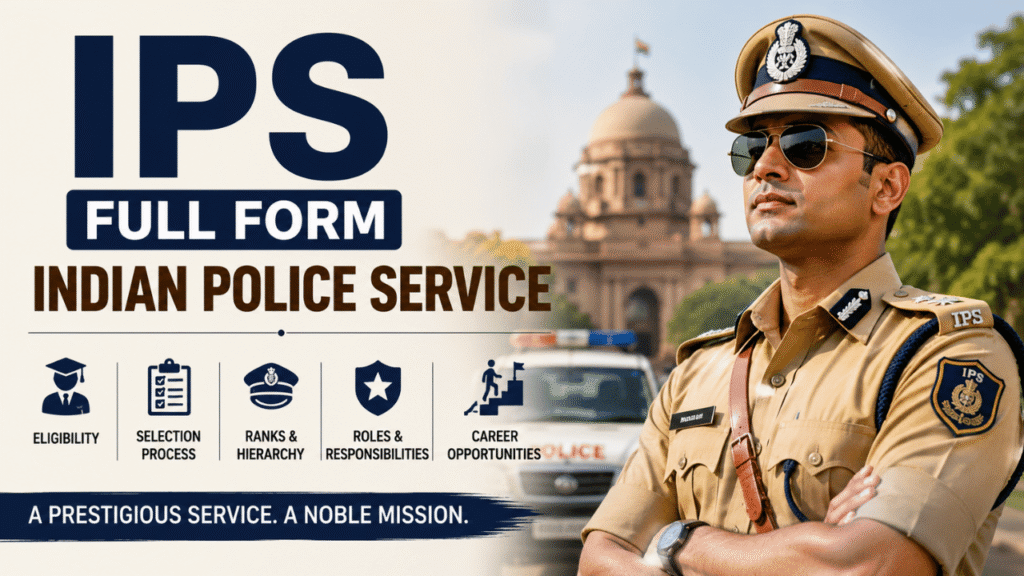
While reading content for government exams, police officers, or civil services in India, if you have encountered the word IPS, then you must be wondering what it exactly means. IPS full form – Indian Police Service is one of the most coveted and esteemed civil services in India. In this post, we will cover all that is associated with the IPS full form, like its history, selection of an officer, rank hierarchy from junior to senior level positions, eligibility criteria, and the frequently asked questions about this profession.
What Is the IPS Full Form?
IPS full form is Indian Police Service. It is one of the three All India Services along with Indian Administrative Service (IAS) and Indian Forest Service (IFS), which means officers recruited through this service may be posted in any state or union territory of the country irrespective of home state. Knowledge of the IPS full form is simply one aspect; the service itself bears much more significance in terms of responsibility, prestige, and maintenance of law and order in India.
Officers inducted through this service command the district, state, and national police forces, overseeing everything from community policing to counter-terrorism operations and internal security coordination.
An Overview of the History of IPS Full Form
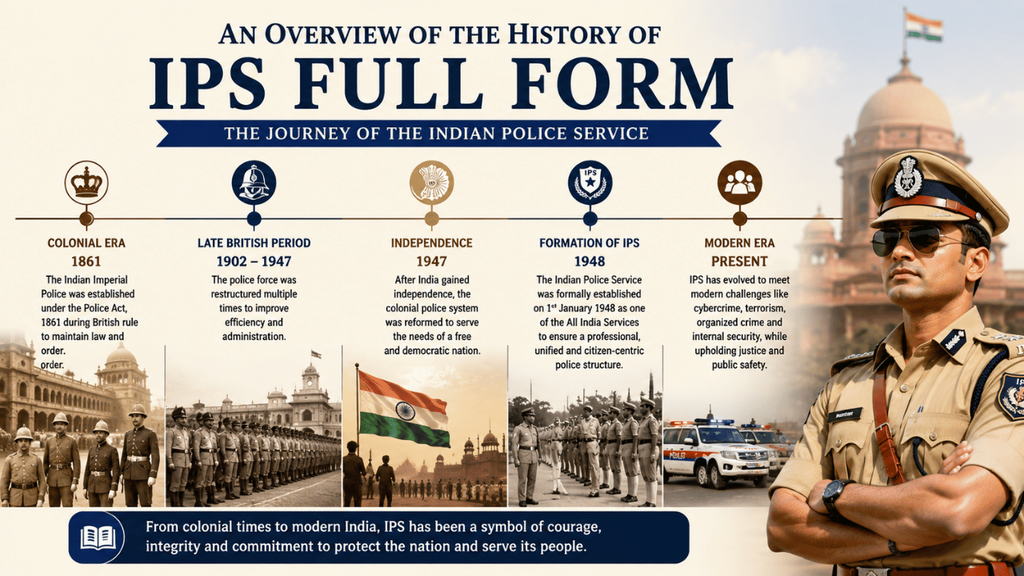
The system has its roots in the former colonial Indian Imperial Police, established by legislation that aimed to impose more structure on a policing approach within British India. After the independence of India in 1947, this force was restructured and renamed, giving birth to what we now know as the IPS full form, i.e., Indian Police Service. That change was a huge development, as the service was reorganised to meet the demands of a post-colonial free society and not a colonial administration.
Since that time, their purpose has changed dramatically to adapt to new challenges such as cybercrime, networks of organized crime, and other border security matters while retaining the basic framework established generations ago.
How Officers Are Selected
Basically, recruitment into the service, where the highest post of IPS thoroughly exist, is done mainly through the Civil Services Examination, which is held once a year by the Union Public Service Commission (UPSC). The sheer number of applicants each year creates a huge gap among the available limited seats; thus, it is considered to be one of the most competitive examinations in the world.
The examination itself is a three-stage process where
Preliminary Examination. The preliminary stage consists of two objective-type papers, usually consisting of the General Studies paper and the Civil Services Aptitude Test (or CSAT), and is only a screening stage that selects candidates to move on to the more demanding part.
Main Examination. It is a much more elaborate stage as there are 9 papers which include essay writing, general studies, and an optional subject for the candidate to choose. Most of the actual evaluation and ranking occur right here.
Personality Test (Interview). Shortlisted candidates from the Main Examination are also invited for a personal interview where each candidate’s overall temperament for a career (and specifically public service), communication skills, and decision-making ability are assessed.
Those candidates who get through all the 3 stages and get a rank under the given cutoff for police services are also allotted the Indian Police Service, which means their journey with the department (the full form of IPS) officially starts. Understanding the IPS full form is important for candidates who are preparing for the UPSC Civil Services Examination and considering a career in policing.
Also Read: NSG Full Form | SDM Full Form | PCS Full Form | SPG Commando Full Form
Eligibility Criteria
Before appearing for a UPSC exam related to a career in the service corresponding to the full form of IPS, candidates must satisfy some basic eligibility criteria.
| Criteria | Requirement |
| Nationality | Must be a citizen of India |
| Minimum Age | 21 years |
| Maximum Age | 32 years (with relaxations for reserved categories) |
| Educational Qualification | Bachelor’s degree from a recognized university |
| Number of Attempts (General) | 6 attempts |
| Number of Attempts (OBC) | 9 attempts |
| Number of Attempts (SC/ST) | Unlimited, up to age limit |
There are also criteria for physical fitness because the work is on active duty, and you have to fulfil minimums such as height, chest measurement, and vision standards according to your category and gender. Along with knowing the IPS full form, aspirants should understand the eligibility requirements before applying for the Civil Services Examination.
Training and Probation
Candidates who get selected for the service represented by IPS, don’t directly go to field postings after getting selected. They first train at the Sardar Vallabhbhai Patel National Police Academy in Hyderabad (the apex training academy for all officers joining this cadre). Training usually lasts for about two years and covers a combination of academic studies, physical training, weapons training, riding practice, and field experience with state police units.
They also go through a period of district attachments where they are posted directly under senior officers and gain the in-practice knowledge of policing before being put in independent charge of their respective postings. It’s designed to prepare candidates for the wide-ranging duties they’ll take on once they get through their probation period and start at their first independent posting, combining training in the classroom with practical field experience. Learning about the training process gives candidates a clearer picture of what the IPS full form represents beyond its basic expansion.
Cadre Allocation
Post training, officers are fixed in a cadre of the state, which is where they will be serving for the most time in their career. The service-linked cadre allocation, which constitutes the IPS, also considers the preferences of candidates and is framed with a view to achieve equitable distribution of officers across different states in their home state in some cases, and other states in others. This balances administrative equilibrium, preventing the federal possibility of misusing the police in any one region, and discourages localism among mid-level officers as well, which can engender their own preferred perversions; ultimately encouraging more national police-sector ideological cohesion over time rather than overreliance on non-independent, locally recruited officers.
Rank Structure
After selection, officers start at an entry-level rank within a department of the IPS and progressively rise through the ranks by seniority (i.e., a year of service), performance, and available positions.
| Rank | Typical Years of Service |
| Assistant Superintendent of Police (ASP) | 0-4 years |
| Superintendent of Police (SP) | 5-9 years |
| Senior Superintendent of Police (SSP) | 9-13 years |
| Deputy Inspector General of Police (DIG) | 14-18 years |
| Inspector General of Police (IG) | 19-25 years |
| Additional Director General of Police (ADGP) | 26-30 years |
| Director General of Police (DGP) | 30+ years |
In the state, you have as the top officer and is usually controlling the entire police department for that whole state. People at the apex of their career in the service as defined by IPS full form can also be placed on central deputation to central agencies such as the Central Bureau of Investigation or even the Intelligence Bureau and Research and Analysis Wing.
Roles and Responsibilities
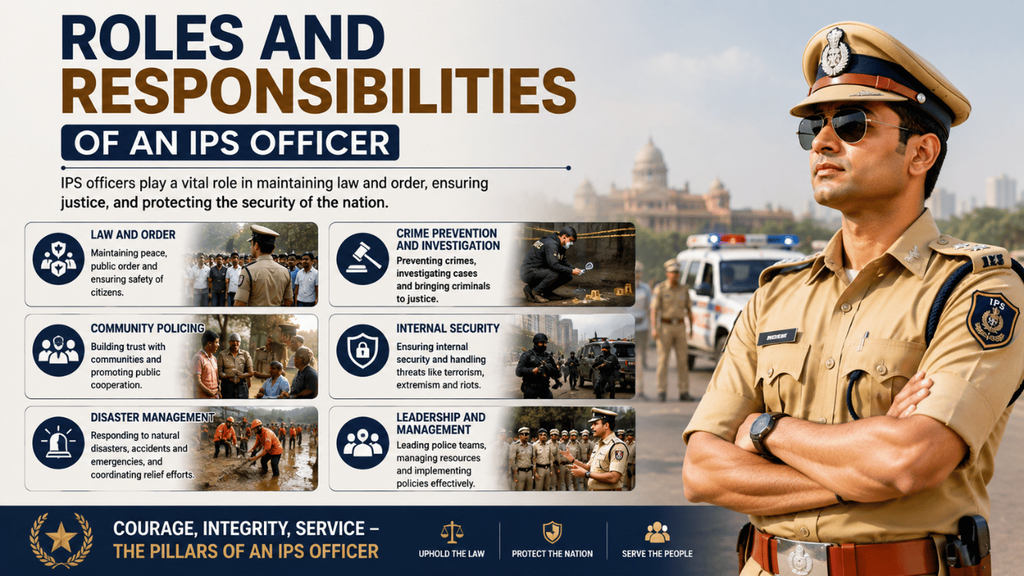
Based on the need of the territories assigned, IPS officers carry out a wide spectrum of functions depending on their posting/ rank. Common responsibilities include:
- Maintaining law and order at the district and state level
- Crime Investigation and control over the police station
- Traffic control for large public events and crowd management
- Crisis Response and Emergency Management Coordination
- Spearheading counter-terrorism and anti-insurgency operations in sensitive areas
- Overseeing special units such as cybercrime cells and forensic departments
- Working in conjunction with other government authorities and agencies to represent the police department
Career Growth and Deputation Opportunities
Attraction of joining the service associated with IPS full form is that there are many such career paths in addition to state-level policing available. At the national level, officers can be posted to agencies, and international postings through organisations like the United Nations or central specialised departments that deal with intelligence, investigation, or internal security. This flexibility, along with an organized promotion calendar, signifies that it is an attractive choice for a long-term career option in case you are interested in public service and law enforcement.
Importance of IPS Full Form for Aspirants
We all know what IPS means, but for the UPSC aspirants out there, that understanding goes beyond just knowing what it stands for on their exam paper. It indicates a real understanding of the service/structure and its history, and what the office entails. This type of fundamental knowledge is exactly the kind that interview panels frequently test candidates on, as having a clear understanding of where the service came from and what it does often indicates real interest and preparation, rather than just cramming for an exam.
Also Read: Full Form of CTC | Gross Salary Meaning | Conveyance Allowance Meaning
Conclusion
For UPSC aspirants, remembering the IPS full form is only the first step toward understanding the responsibilities, career path, and importance of the Indian Police Service. The IPS full form which refers to Indian Police Service, is one of the most coveted and challenging professions in India under the ambit of Civil Services. The service traces its roots back to the colonial period and has been moulded over time to fit the demands of modern policing in the nation. As an aspirant preparing for the UPSC Civil Services Examination, addressing the full form of IPS along with its selection process, rank structure, and powers is an integral part of forming a holistic and admission-based study approach.
Frequently Asked Questions
1. What is the IPS full form?
You would have heard about IPS, which is Indian Police Service (which is one of the three All India Services in India).
2. How can someone join the IPS?
The UPSC Civil Services Examination should be qualified for an IPS, and one’s name on the merit list, after other services, must be among the first few candidates’ names.
3. What is the age limit for IPS?
The overall upper age limit is 21 to 32 years, subject to some exclusions for qualified reserved candidates.
4. Does IPS require a particular academic background?
No. Anyone from any recognized stream or discipline is eligible to apply
5. Where can an IPS officer be posted?
They might join organizations like the CBI, IB, RAW, and also the UN.