






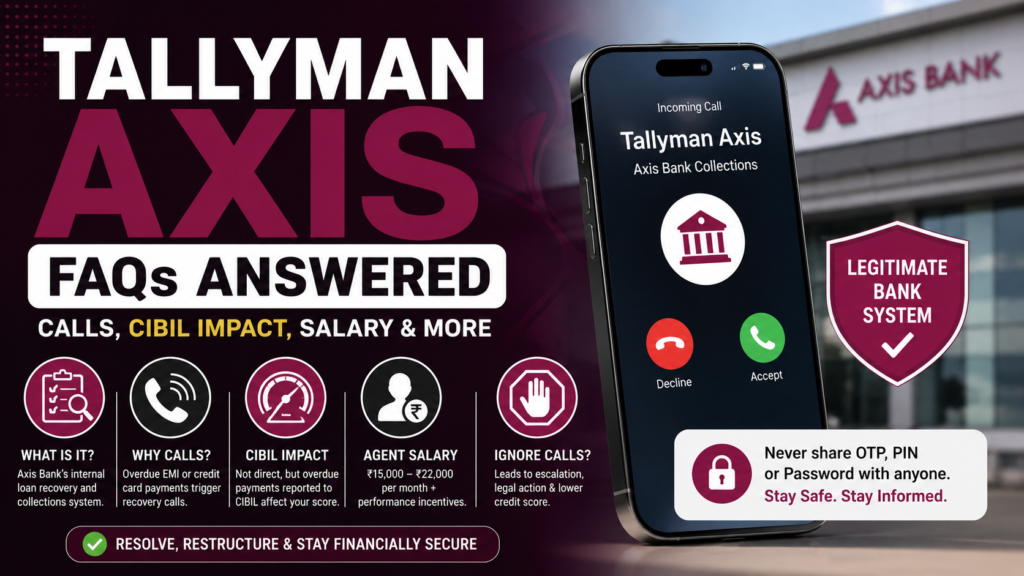
If you’ve been receiving calls from someone speaking about Tallyman Axis or “Axis Bank Tallyman,” you might have two questions: what’s that, and do I have to worry? The brief answer is that Tallyman Axis is the loan recovery and collection system that Axis Bank uses, and it’s definitely not a fraud. However, the long answer entails the working of the loan recovery system, the reasons your account was flagged, what follows next at every stage of the loan recovery process, and what you need to do and refrain from doing to evade falling into its trap.
What Is Tallyman Axis?
Axis Bank, as an example, uses Tallyman Axis, its internal collections and loan recovery management platform, to maintain records of overdue borrower accounts, to assign agents to recover loans from borrowers currently experiencing payment difficulties, and to track repayment histories over time (as arrears age cases can be escalated through various stages). Neither is it a separate company, nor a third-party agency, nor an independent financial product. Proprietary software that operates within Axis Bank’s credit risk infrastructure
If a customer misses out on a loan EMI, or defaults in paying for the credit card bill or part of any credit obligation with Axis Bank, the system immediately flags the account. From there, the system routes the account to a recovery workflow that dictates which customer is called, when they are called, and what resolution path is pursued.
Tallyman relates to traditional accounting and record-keeping; a tallyman was historically someone who made scores, tracked debts, and kept credit records. This platform does precisely this in digital form for banking.
Why Are You Getting Tallyman Axis Calls?
The calls you’re receiving about this system are due to your Axis Bank account being classified as overdue in Axis Bank’s internal system. It can happen due to several reasons:
| Reason | Explanation |
| Missed Loan EMI | Even a single missed installment triggers the recovery workflow |
| Unpaid Credit Card Bill | Partially paid or completely unpaid card dues enter collection cycles |
| Payment Not Reflected | Payments made but delayed in processing can temporarily flag accounts |
| Multiple Cycle Default | Accounts overdue across two or more payment cycles enter escalated tracking |
| Technical Payment Failure | Failed transactions that were not retried before the due date |
The bottom line is that the first phone call you get does not automatically put you in the hot seat. For a sizeable number of individuals, it is brought on by just one missed payment that can be addressed easily and effectively. The most important thing is your reaction.
Also Read: CGDA Auditor | Conveyance Allowance Meaning
Is Tallyman Axis a Scam?
The question that has made many come here to this subject in the first place; according to Tallyman Axis itself, the direct answer is – Yes, it is due and under the form of a recovery system by Axis Bank. Anything referenced in the calls is a part of the bank’s legal collections process.
On the other hand, having a real system provides another way for scammers to impersonate. Real Tallyman Axis recovery agents will always have the amount due in your account, your loan or card account number, and some basic transaction history. What they will never say:
- Your ATM-PIN or debit card number
- The One-Time Password (OTP) sent to your mobile number registered
- The user name (or password) used in web banking
- Immediate cash payment into a person’s own account
If the caller asks for any of the above, consider it as fraud rather than actual recovery communication. The only safe action to an unverified call is to hang up and reach Axis Bank’s official customer care to know your account status in reality.
Understanding The Functionality Of Tallyman Axis Recovery System
The recovery workflow in Tallyman Axis is not arbitrary – it has a structured escalation logic according to the ageing of the account:
Stage 1: Early Delinquency (1-30 Days Overdue)
The system can also automatically send reminders via SMS and email. Usually, no recovery agent is appointed at this stage. At this point, there are no lasting consequences; just a simple payment solves everything.
Stage 2: Active Recovery (30-90 Days Late)
The platform waits until an account has aged 30 days overdue with no resolution to assign a recovery agent who begins targeting the client by contacting them directly via phone. Frequency of calls increases and takes a more structured form. At this point in time, the bank would prefer a 100% payment or an extended restructuring repayment plan.
Stage 3: High Risk Escalation (90+ Days Overdue)
Any account that has not been tracked after 90 days is placed in what the banks term as “NPA-watch”. This may include undertaking field visits, carrying out legal review, and making a settlement offer. This one-time payment is typically the lesser amount than the defensive cost of successfully defending Validity.
Stage 4: Legal Action
In case of continued non-engagement, Axis Bank is within its rights to initiate legal proceedings on the basis of applicable loan agreements. The problem is that this stage is dodged in virtually all cases by early engagement.
Tallyman Axis Login – Who can use it?
No customer-facing login portal, no public app store access, and no signup process for borrowers. The only users for the system are internal Axis Bank employees – from the credit risk, collections and recovery units, as well as approved field recovery agents.
Within it, bank staff can:
- See a full overview of a customer’s account and repayment history
- Record each call made and its outcomes
- Track payment promises and follow up on missed commitments
- Real-time update of account status when payments are received
- Identify accounts to move into higher-priority recovery categories
That is the reason each time a recovery agent calls you, it creates a record of the entire contact; all attempts to connect and its resolution are recorded by the system.
Tallyman Axis App
There is a mobile app available for registered local field recovery agents to conduct all work outside of the office. The app is purely internal, with no public availability through Google Play Store or Apple App Store.
| Feature | Purpose |
| GPS-tagged field visits | Records that an in-person visit occurred at a specific location |
| Real-time payment logging | Immediately updates account status when a payment is received |
| Promise-to-Pay tracking | Logs verbal commitments and schedules follow-up reminders |
| Case escalation management | Allows agents to flag accounts for higher-level review |
| Call history logging | Records all contact attempts and outcomes |
If a website even hints that they provide a downloadable customer app, be very suspicious; no such app is publicly available.
Tallyman Axis Salary – Recovery Agent Pay
Here is the Tallyman Axis agent salary structure for those of you opting for the collections and recovery job at Axis Bank instead of handling a recovery call:
| Role | Monthly Salary Range |
| Collection Agent (Entry Level) | ₹15,000 – ₹22,000 |
| Senior Collection Agent | ₹22,000 – ₹30,000 |
| Team Leader | ₹30,000 – ₹45,000 |
| Collections Manager | ₹45,000 – ₹70,000 |
A critical aspect of this compensation model is that performance incentives make up a large portion of total earnings. The compensation system for recovery agents is usually tied to a bonus based on the value of dues collected. An agent on the top of their game can earn significantly above the base monthly amount with these incentive bonuses, which is why collections is also one of the more lucrative entry slip banking jobs offered for individuals looking to go into a sales-type role.
Does Tallyman Axis Have An Impact On Your Credit Score?
The system itself is not a report to credit bureaus. This is an internal bank tracking tool and channel, not to be confused with credit bureau communication. But, of course, the overdue status,, which activates activity in this system definitely does impact your credit score from Axis Bank’s normal reporting to CIBIL, Experian, and Equifax:
- Accounts overdue 1-29 days: Another area may not be reported but initiate internal flags
- Accounts Over(30) Days: Usually means that status for credit bureaus reporting of being overdue
- Accounts more than 90 days overdue: Treated as NPA, huge negative impact in CIBIL
- Settled accounts: These show up on credit reports as “settled” instead of being marked as “closed,” which has its own scoring impact.
Quick resolution of overdue amounts in the initial time frame will avoid Credit Bureau Reporting to safeguard your CIBIL score.
How to Deal with a Tallyman Axis Call
To strategically manage a recovery call, you need to keep your head and stick to the process:
Step 1- Verify the caller. Is whatever their Employee Identification No. – which recovery agency or Bank Branch do they represent? Real agents will be more than happy to give this.
Step 2- Verify your account by yourself. Consider verifying the accumulated bill first in Axis Bank’s official net banking portal or mobile app before talking about the payment.
Step 3- Never share OTP, PIN, password, or full card number on call, even with a hint of what the caller may say.
Step 4- Engage, instead of avoid. When a call goes ignored, the timeline for escalation is almost instantaneous. Never leave us in the dark, even to advise us of a temporary financial setback – communication is always better than silence.
Step 5- Explore options. Inquire about restructuring or deferral options, if not paying the full amount instantly is possible for you. Axis Bank has frameworks to support borrowers who are temporarily unable to pay, in common with all regulated banks.
Genuine Recovery Calls vs Fraudulent Ones
| Genuine Call | Fraudulent Call |
| References specific account/loan details | Vague about your account specifics |
| Professional, measured communication | Creates urgency, pressure, or fear |
| Never asks for OTP or PIN | Demands OTP, PIN, or passwords |
| Can be verified through official bank contact | Discourages you from calling the bank |
| Offers structured resolution pathways | Asks for cash payment to personal account |
Also Read: 8th Pay Commission Salary Hike | Gross Salary Meaning
Conclusion
This is not something to be afraid of; it is something to comprehend and respond to judiciously. This is the system that arranges how your Axis Bank account will react when it goes overdue. Resolution is easy to do and free from fallout at the earliest stages. The longer the inactivity lasts, the worse its repercussions are – on your finances, your credit score and your association with the bank. Any recipient of these recovery communications should do the most important thing you can do: respond quickly, confirm what is owed through official channels and agree a cashback solution that fits with current finances. Communication, instead of avoidance, is the real answer at all times.
Frequently Asked Questions (FAQs)
1. Why am I getting Tallyman Axis calls?
You get calls when your loan EMI or credit card payment is delayed.
2. Is Tallyman Axis legitimate?
Yes, this is their recovery model, and it belongs to Axis Bank. Watch out for fraudsters and never share OTPs or PINs
3. Does Tallyman Axis impact my CIBIL score?
Not directly, the overdue payments tracked by it can have an effect on your CIBIL score.
4. How much does a Tallyman Axis recovery agent earn?
The recovery agent gets ₹15,000-₹22,000/month plus incentives.
5. What happens if I leave Tallyman Axis calls unanswered?
If you disregard them, additional recovery action, court procedures, and a lower credit score may follow.