






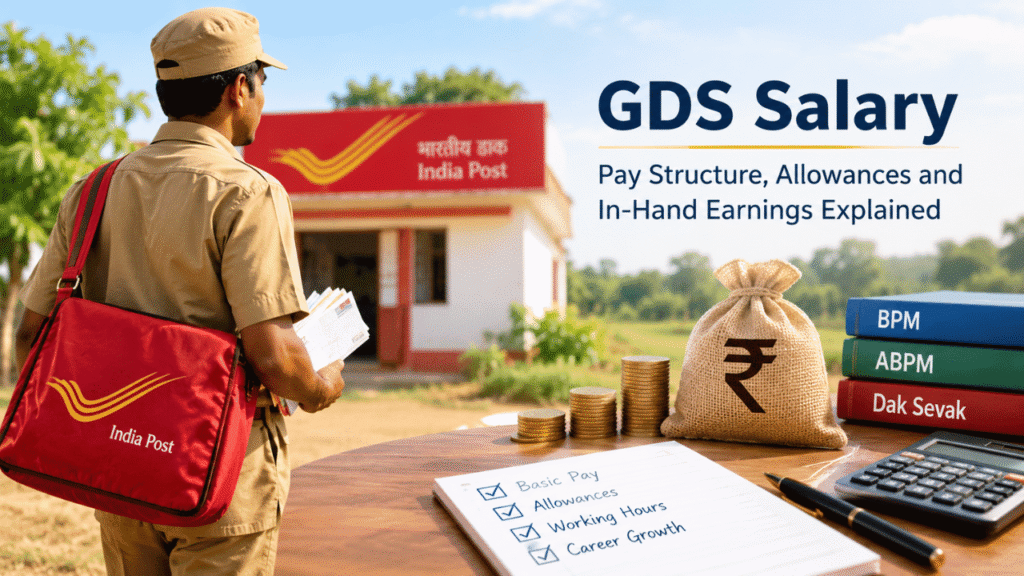
India Post Gramin Dak Sevak is one of the most preferred government jobs due to its stability, simplicity, and ease of access for candidates from all walks of life across India, so lakhs of candidates apply every year. However, it is important to know the GDS salary before applying, as they have a different pay structure from regular government jobs. This guide will explain precisely how the Indian government determines GDS pay, which post has what kind of payments, what allowances are encompassed within it, and, in a general sense, try to provide readers with an idea about the financial situation in terms of money that candidates can expect at the end of each month.
What is GDS and Who Is Eligible?
It does help to have a grasp of what this role really means in the realm of GDS salary before we dig into specific numbers. Gramin Dak Sevak, in short known as GDS, is a postman of India Post, overall the country, for rural and semi-urban areas. GDS employees are working in the nature of extra-departmental agents is not linked to normal central government employees and therefore do not come under the common Pay Commission which applies to all government staff.
GDS includes Branch Postmaster (BPM), Assistant Branch Postmaster (ABPM) and Dak Sevak. The salary structure of GDS will moreover differ depending on some aspects like each of these roles, which bear to a certain extent unique obligations. GDS is one of the easiest Government jobs to apply for, as eligibility for these posts only requires a 10th standard pass certificate and basic knowledge of the local language and the ability to cycle, since GDS workers are assigned to deliver local mail in rural areas.
GDS Salary Overview
| GDS Salary Overview | Details |
| Job Name | Gramin Dak Sevak (GDS) |
| Main Posts | BPM, ABPM, and Dak Sevak |
| Salary Structure | Time Related Continuity Allowance (TRCA) |
| Working Hours | Generally 4–5 hours per day |
| Monthly Salary Range | ₹10,000 – ₹29,380 |
| Approx. In-Hand Salary | ₹9,000 – ₹18,000 |
| Major Allowances | Dearness Allowance, Office Maintenance Allowance, Fuel/Travel Allowance |
| Annual Increment | Generally 3% on basic pay |
| Minimum Qualification | 10th standard pass |
| Career Growth | Promotion opportunities to Postal Assistant/Postman roles |
The Actual Calculation of GDS Salary
The most crucial information about GDS salary is that it does not follow the usual Pay Commission system which applies to most government employees. GDS pay is, instead, based on a mechanism known as the Time Related Continuity Allowance or TRCA. This means that GDS salary will be decided according to the allotment of working hours related to the post, generally four or five hours per day, and years of uninterrupted service, and additionally not by a fixed month-to-month Pay Matrix like regular government staff.
It is this structure that means salary of GDS can differ quite significantly in a single post category on the basis of whether a worker does a 4-hour or 5-hour daily schedule; before additional years of service, which are taken into account for staged increases.
GDS Salary Structure by Post
The following are the GDS salary ranges for different post categories of GDS service according to official notifications and popular pay scales:
| Post | Monthly Salary Range |
| Branch Postmaster (BPM) | ₹12,000 – ₹29,380 |
| Assistant Branch Postmaster (ABPM) | ₹10,000 – ₹24,470 |
| Dak Sevak | ₹10,000 – ₹24,470 |
From this table, you can see that the salary of GDS for a Branch Postmaster is normally higher than the ABPM or Dak Sevak positions, as it requires more responsibilities of working from BPOs rather than independent delivery posts.
GDS Salary Based on Working Hours
As the TRCA system directly links GDS salary with daily working hours, it is important to study the impact on monthly pay.
| Working Hours | Approximate Monthly Salary |
| 4 hours per day | Around ₹20,470 |
| 5 hours per day | Around ₹23,870 |
The hour-based contract is one of the most peculiar aspects of salary of GDS or standard civil service pay, since two people working in very similar (and even identical) jobs could receive widely varying monthly salaries simply by virtue of their post having been assigned a different number of hours on paper.
Also Read: SRPF Salary | FDA Salary in Karnataka | IB Security Assistant Salary
Annual GDS Salary Overview
Candidates can also learn how much GDS jobs pay over the year, which gives them some perspective on what to expect in terms of annual salaries from these roles.
| Post | Approximate Annual Salary |
| Branch Postmaster (BPM) | ₹1,30,000 – ₹1,50,000 |
| Assistant Branch Postmaster (ABPM) | ₹1,20,000 – ₹1,30,000 |
| Dak Sevak | ₹1,20,000 – ₹1,30,000 |
Of course, these figures appear far lower than many other government jobs annual salaries but one must keep in mind that GDS salary is often supplemented with allowances and postmen retain the freedom to pursue secondary income generating means or of they so wish male lots during their work hours since most of these posts are part-time.
Allowances Included in GDS Salary
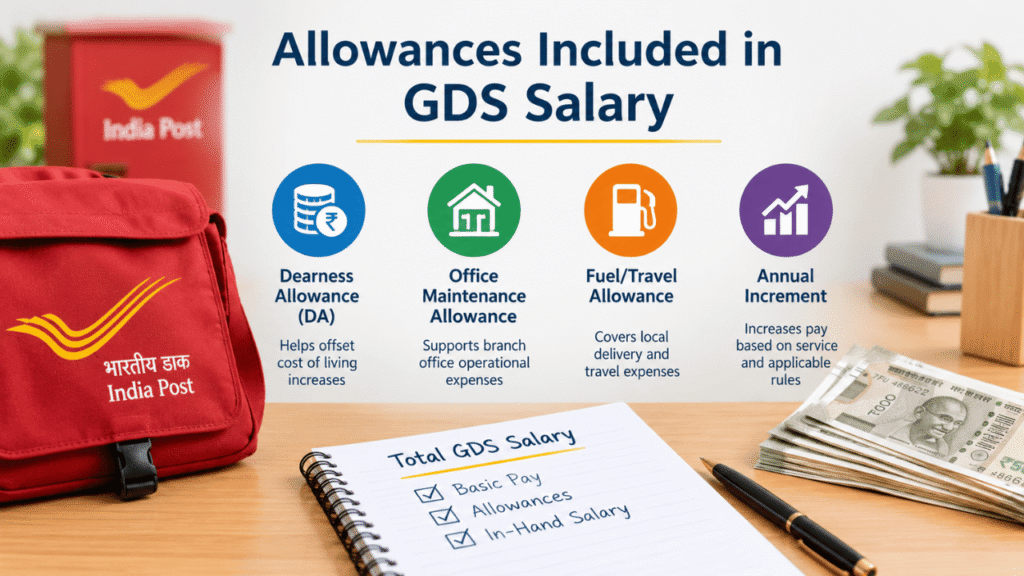
Apart from the base TRCA-based pay, GDS salary also consists of other allowances that count towards total monthly income. Common components include:
- Dearness Allowance (DA): Adjusted periodically, usually semi-annually, to combat cost of living increases.
- Office Maintenance Allowance: Exclusive and meant Applied to the Ownership of Branch Postmasters whose duty is only an operational functioning office
- Fuel or Travel Allowance: Provided to assist workers who are engaged in local delivery routes.
- Annual Increment: GDS employees are eligible for an annual increment, which is generally 3% on basic pay (so the GDS salary gradually increases even without any change in post.
These allowances mean that the actual salary of GDS received each month is usually slightly more than the basic TRCA number – particularly for Branch Postmasters, who receive extra office maintenance assistance.
Will GDS be a normal Departmental Job?
This is one of the more prominent impasses for candidates searching for GDS salary and career prospects. GDS is classified as an extra-departmental post rather than a regular, permanent central government job. This implies that GDS workers neither have a pension structure, a full benefits package, or salary revisions with respect to the Pay Commission, which other standard postal department employees enjoy. Regardless, GDS jobs still provide significant employment assurance, a promotion trail into regular postal department positions through a phased examination process over time, as well as acknowledged government-linked jobs being among the features; this is why the GDS continues to be an appealing option for several diploma candidates, especially in very soft-impact work frontiers.
Career Growth Opportunities Within GDS

The salary of a GDS worker at the entry level may be low compared to other entry-level civil service jobs, but it does actually consider career progression. Over time, GDS workers, including Branch Postmaster or Assistant Branch Postmaster employees, become eligible to apply for promotion into regular Postal Assistant or the Postman positions of India Post directly from the GDS network, which comes with much higher pay scales as well as proper Pay Commission benefits and greater job security compared to their corresponding initial GDS post.
It’s this advancement potential that is one of the primary reasons many candidates consider an entry-level GDS salary to be a stepping stone instead of an end goal, viewing the role as simply one part of their overall career path in India Post’s larger organizational hierarchy.
GDS Salary and Contractual Pay Commission
As GDS employees do not fit in the general Pay Commission structure, talks on their pay revision take place a little differently from regular government personnel. Normal central government staff have salary revision linked to each Pay commission and for GDS it has traditionally been separate committee review of the GDS cadre and plus Dearness Allowance in periodic phases. Future GDS salary expectations should also be researched in line with the knowledge that any increases are most likely to arise from a GDS-specific pay review and will not automatically mirror wider central government pay commission recommendations.
In-Hand GDS Salary
After all allowances and deductions, the most realistic in-hand GDS salary for many workers comes within a strict range.
| Post | Approximate In-Hand Monthly Salary |
| Branch Postmaster (BPM) | ₹12,000 – ₹18,000 |
| Assistant Branch Postmaster / Dak Sevak | ₹9,000 – ₹17,000 |
Note that, in-hand GDS salary numbers are different for the same circle, assigned working hours, and years of service since increments and allowance eligibility play a crucial role in deciding the final amount that is received by any worker on a monthly basis.
Why GDS Remains a Popular Job Choice
However, although the GDS salary is relatively modest in comparison with other government roles, this job remains immensely popular, and every time a recruitment round is run, tens of thousands apply for only a handful of jobs. This can be attributed to a variety of reasons, including less stringent academic requirements, relative ease of application and selection primarily on merit (with very little focus on the lengthy written examination unlike most other places), lax part-time working schedules and the long-term security associated with any position affiliated with the government.
Except for many rural Indian candidates, who aspire to stay connected with their local area even while landing up in a well-recognized government job, the GDS salary and overall GDS position is not a dream at all, but an actual viable career move.
Also Read: SPG Commando Salary | Cobra Commando Salary | MTS Havaldar Salary
Conclusion
This means that GDS salary is not a single number but depends on multiple factors based on the specific post, working hours assigned, years of service, and various allowances. In general, the monthly salary of GDS will be between ₹10,000 and ₹ 29,380 depending on the Role and Hours of work, and in-hand pay can be between ₹9,000 and ₹ 18,000 (after deduction). Together with real promotional avenues into permanent postal department jobs, GDS continues to be one of the easiest and most widely selected entry points to Government service throughout rural India.
Frequently Asked Questions
1. How is GDS salary calculated?
It suggests that the GDS salary is based on TRCA (Time Related Continuity Allowance), working hours, and years of service.
2. Does GDS salary include allowances?
Yes, brokerage, which covers allowances like Dearness Allowance and the Office Maintenance Allowance for BPMs)
3. Is GDS is a regular government job?
No, GDS is outside of any department and does not comply with the normal Commission structure.
4. Can GDS employees get promoted?
So, eligible GDS can be appointed on Postal Assistant / Postman with a higher pay.
5. What are the annual GDS salary details for a Branch Postmaster?
A BPM should draw in between ₹1.30 lakh and ₹1.50 lakh per annum according to the service and working hour.