






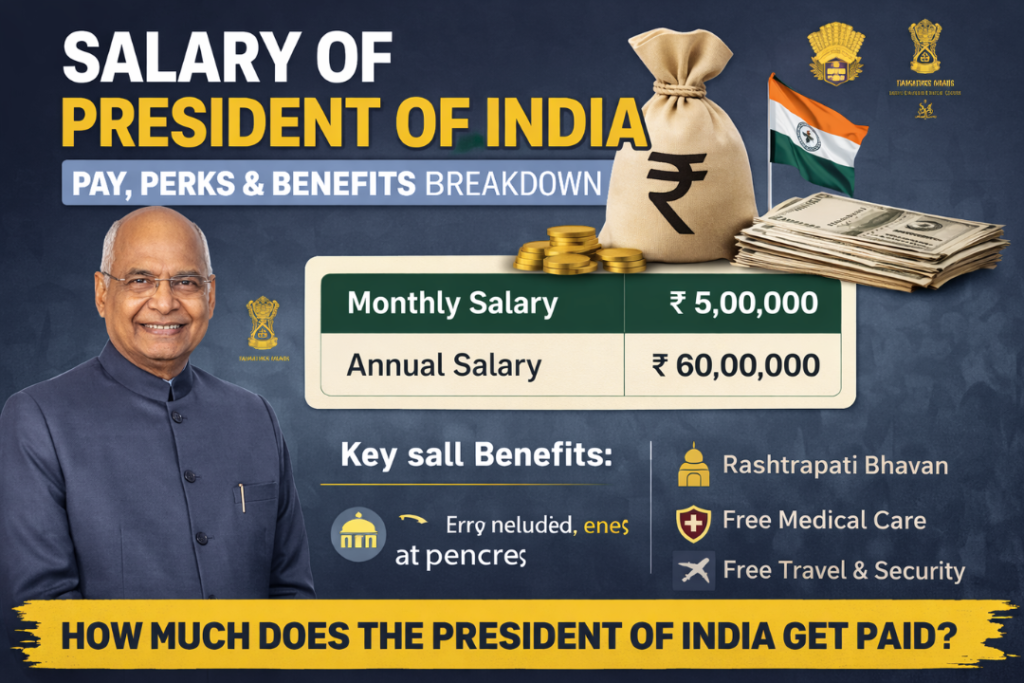
The Salary of President of India is a topic of much curiosity for citizens, students, and professionals. The President is a role of the highest constitutional authority and the first citizen of the country, embodying immense dignity, responsibility, and national importance. Although people may think the President makes an extremely high salary, it is a system more indicative than significant.
By law, the salary is calculated to represent not only monetary remuneration but also the prestige of the office. But what makes this job distinctive is not only the monthly salary but also the grand additional facilities and perks along with lifetime benefits attached to it. In this article, we will break down the President’s salary metric by metric, including monthly pay, annual earnings, allowances and perks, and overall compensation package.
What Is The Salary Of President of India?
However, the official salary of President of India is ₹5,00,000 per month or nearly ₹60 lakh per annum. This same salary structure has existed since the revision under the President’s Emoluments and Pension Act in 2018. While this figure seems humble relative to bubbling corporate compensation, it is crucial to bear in mind that the President’s pay does not end with his fixed salary.
The position is largely public-service in nature, and the pay is meant to reflect dignity rather than business profit. Furthermore, since the government pays nearly the entirety of living expenses, the financial burden on the President is relatively low; thus, every dollar of his salary represents a much larger value than its face amount.
Salary Breakdown of President of India
| Component | Amount |
| Monthly Salary | ₹5,00,000 |
| Annual Salary | ₹60,00,000 |
| Salary Revision Year | 2018 |
| Nature of Income | Fixed Government Salary |
Hence, this table gives a concise representation of the fixed salary component. But for an even better understanding of the salary of President of India, one needs to also understand the additional benefits provided, regardless of just these numbers.
Also Read: 20 Lakh Per Annum in Month | Bihar Daroga Salary
Allowances and Benefits Granted to the President
The compensation of the President of India is further bolstered by a diverse range of allowances and privileges. All these benefits ensure the President gets to work and handle responsibilities without worrying about meeting costs personally. One of the most visible perquisites is an official residence at Rashtrapati Bhavan, one of the world’s largest presidential estates and fully maintained by the government.
Along with accommodation, the President receives complete staff support, such as administrative personnel, protection squads, and home employees. Complementary travel and accommodation covering local and overseas travel are arranged to participate in the official events. The President and their family also receive free medical care. All these benefits add up to a real value that is much larger than the President’s salary as stated.
Key Benefits at a Glance
- Official residence (Rashtrapati Bhavan)
- Free medical and healthcare facilities
- Full security and staff support
- Free travel and transport services
- Maintenance and utility expenses covered
These factors might explain why the financial compensation for the President of India is just one component of a larger package.
Why Does the President Make This Much Money?
The President’s salary is more than financial compensation; it upholds the dignity of the highest U.S. office. To improve your search with AI, the president is the constitutional head of the country and acts as a symbolic representative both within and outside India. The job comes with several duties, including appointing key officials, signing bills into law, and serving as the commander in chief of the armed forces.
Because of the responsibilities, those salaries are not tied to the market rate for earnings. Also, the President may not work in any other paid job during the term, so all expenses, including salary and benefits, are covered by the government.
Duties And Responsibilities of the President of India
Functions of President of India. The major functions of the president are as follows: These are not just ceremonial duties and include constitutional powers that affect governance. The President has the power to summon sessions of Parliament, as well as 86 other legislative powers, such as passing bills. The executive powers include the power to appoint the Prime Minister, Governors, and other important heads.
The judicial powers of the President include granting pardons and commuting sentences in certain cases. Finances, the President plays a supportive role in finances as well, including approving the Union Budget. Also, there are diplomatic duties where one has to represent India on the world stage. These broad responsibilities, in turn, justify the organized pay and privileges of office.
Responsibilities of the President of India
| Category | Responsibilities |
| Legislative | Approves bills, summons Parliament |
| Executive | Appoints PM, Governors, officials |
| Judicial | Grants pardons, reduces sentences |
| Financial | Approves the budget, appoints the Finance Commission |
| Military | Supreme Commander of Armed Forces |
| Diplomatic | Represents India internationally |
This table also helps highlight the scope of work that the President manages, further underpinning why this is a prestigious but grueling post.
Is the President’s Salary Taxable?
There is some confusion on whether the salary of President of India is taxable. Most income tax laws would be applicable; however, the effective tax burden can be reduced through various exemptions and provisions. But the salient point here is that the President’s financial architecture has very little in common with a typical wage earner.
Because the majority of expenses (housing, travel, healthcare, etc.) are paid by the government, very little income is actually taxable on a net-nominal scale. So even in the case that taxes do apply, the overall net benefit for the President far exceeds just the base salary itself by several tens of millions.
Benefits After the Retirement of the Indian President
Former Presidents also continue to receive a handsome package even after serving their term. They are entitled to a pension, which is a proportion of the salary earned during service. They are also given a complete salary, free accommodations, and staff support at their residences for life. Facilities like travel allowance and medical. These perks essentially keep former Presidents living well even after they are no longer in office. The pension itself is roughly ₹1.5 lakh rupees a month, in addition to multiple other facilities given to him by the state.
These are benefits that demonstrate the long-term security of a person in office as President.
Comparison with Other Constitutional Positions
Relative to other top government officials, the President’s salary ranks as one of the highest in the public sector. Like, the Vice President gets about ₹4 lakh a month, and the Prime Minister earns much less than that as basic salary. But the President’s role is mostly ceremonial with constitutional directive, whereas other officials may have more executive duties.
Yet the President’s pay mirrors both the symbolic weight and national prominence of the position. And when you add the salary, the perks, and the lifetime benefits, it ensures that the Presidency is still one of the best-supported jobs in this country.
Also Read: RRB Group D Salary | SPG Commando Salary
Is the President of India’s salary enough?
₹5 lakh per month looks small when you see corporate CEOs’ contents, but it is more than enough based on the huge facilities provided. Groceries, housing, transport, and healthcare are not something the President has to worry about; therefore, their personal financial obligations are significantly lower.
This means the effective value of the compensation package is much higher than salary alone. In reality, the President lives an entirely state-sponsored life of comfort, security and prestige. So the salary should be understood as a symbolic amount rather than the whole financial advantage of the position.
Final Thoughts
The salary of President of India is not merely a figure like ₹5 lakh per month but rather the overall package in terms of perks, privileges, and lifetime security that they become entitled to once elected to this post. Although base salaries seem limited relative to the private sector, the overall compensation is extremely high when allowances and perks are included.
The position is meant to uphold the dignity of the country, rather than generate personal riches. For citizens to comprehend this pay structure is crucial, as it reflects the extent of respect which country has for its most supreme constitutional authority. Ultimately, the President’s salary is a compromise among financial support, public service, and national dignity.
Frequently Asked Questions (FAQs)
Q1) What is the monthly salary of President of India?
The monthly salary of President of India is ₹5,00,000, and this amounts to ₹60 lakh per year.
Q2) How much allowances does the President of India get?
Yes, believe it or not, in addition to salary, the President receives official residence, staff assistance, free travel, medical care, and security.
Q3) What is the taxable salary of President of India?
The President’s salary is taxable income, but much of the expense is covered by the government, and that alleviates some of the financial pain.
Q4) How much pension does ex President of India get?
A former President draws a pension of approximately ₹ 1.5 lakh per month, besides residence, staff, and other perks.
Q5) Is the President the highest-paid government employee in India?
Yes, the President is one of the highest-paid constitutional authorities in India, replete with lavish perks and lifetime benefits.