





The keyword PCS full form is widely searched by students and aspirants who are preparing for government jobs, especially in the field of civil services. Many candidates come across the term PCS during their preparation but often lack a clear understanding of what it actually means and what kind of career it offers.
If you are planning to build a career in public administration at the state level, understanding PCS becomes very important. It is not just about knowing the full form, but also about understanding the responsibilities, career growth, and lifestyle associated with it. In this article, we will explain everything in a simple and easy-to-read manner, including the PCS full form, its meaning, eligibility, salary structure, exam process, and future career scope.
What is the PCS Full Form ?
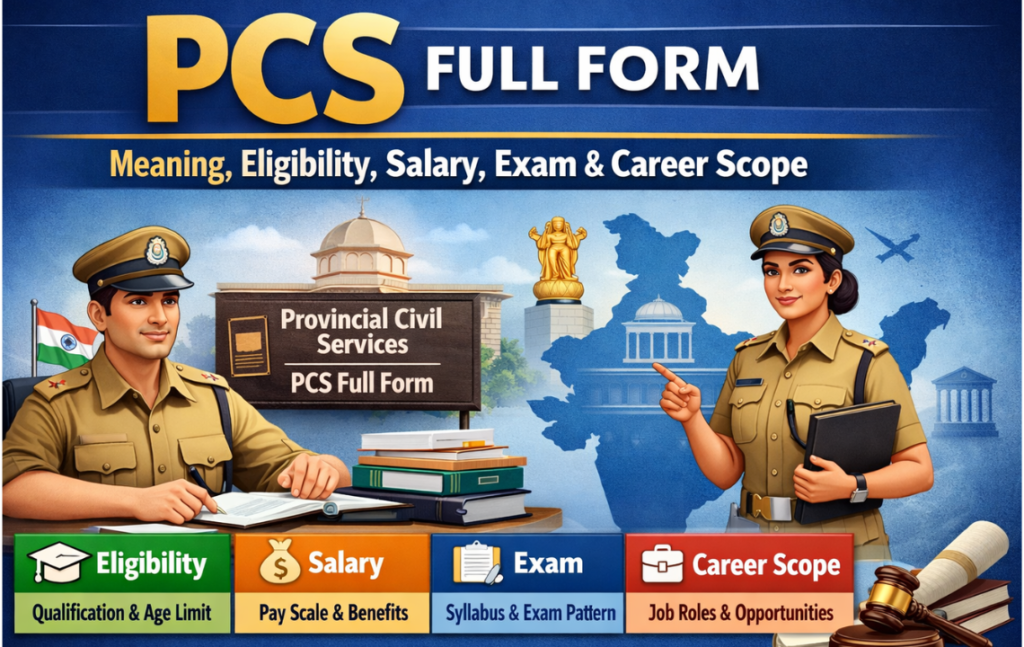
The PCS full form is Provincial Civil Service. It refers to a group of administrative services that operate under state governments in India. PCS officers are recruited through competitive examinations conducted by State Public Service Commissions such as UPPSC, MPPSC, and BPSC.
These officers play a key role in managing the day-to-day administration of the state. From maintaining law and order to implementing government policies, they are deeply involved in governance at the ground level. In simple terms, PCS officers act as a bridge between the government and the public, ensuring that policies and decisions are properly executed across districts and regions.
Overview of PCS (Provincial Civil Service)
To get a quick understanding of PCS, the following table highlights its main features:
| Feature | Details |
| Full Form | Provincial Civil Service |
| Level | State Government Job |
| Conducting Body | State Public Service Commission |
| Job Type | Administrative |
| Category | Group A & B Services |
| Work Area | District, State, Sub-Division |
PCS is often compared with national-level civil services, but its focus remains on state administration. It provides a strong platform for individuals who want to work closely with local governance and contribute to the development of their state.
What Does a PCS Officer Do?
The responsibilities of a PCS officer are diverse and depend on their specific role and posting. However, their core responsibility is to ensure that government policies and administrative functions are carried out smoothly.
PCS officers are actively involved in decision-making processes that affect local communities. They supervise development projects, manage public services, and handle administrative challenges at the district or sub-division level. Their work directly impacts the daily lives of citizens, making their role both important and impactful.
- Maintaining law and order in assigned areas
- Managing revenue and land records
- Implementing government policies
- Supervising development projects
- Handling public grievances
These responsibilities require strong leadership, decision-making skills, and a sense of responsibility toward public service.
PCS Exam: Selection Process
Becoming a PCS officer requires clearing a competitive examination conducted by the respective State Public Service Commission. The selection process is designed to test a candidate’s knowledge, analytical ability, and personality.
Selection Stages
| Stage | Description |
| Preliminary Exam | Objective type screening test |
| Mains Exam | Descriptive written exam |
| Interview | Personality test |
The preliminary exam serves as a screening stage, while the mains exam evaluates in-depth knowledge and writing ability. The final interview assesses the candidate’s personality, confidence, and suitability for administrative roles.
Also Read: Bipin Rawat Salary | Pooja Dadlani Salary
Eligibility Criteria for PCS Exam
Candidates must meet certain eligibility criteria before applying for the PCS exam. These requirements ensure that applicants have the necessary educational background and maturity to handle administrative responsibilities.
Basic Eligibility
| Criteria | Requirement |
| Education | Graduation from a recognized university |
| Age Limit | 21 to 40 years (varies by state) |
| Nationality | Indian citizen |
A graduate degree is mandatory, and candidates from any stream can apply. Age limits may vary slightly depending on the state and category, with relaxations available for reserved categories.
PCS Officer Salary Structure
The salary is one of the major reasons why candidates search for the PCS full form. PCS officers receive a respectable salary along with various allowances and perks.
PCS Salary Table (Approx)
| Position | Salary Range |
| Entry Level | ₹56,100 – ₹1,32,000 |
| Mid-Level | ₹67,700 – ₹1,60,000 |
| Senior Level | ₹1,44,200+ |
Apart from the basic salary, officers receive Dearness Allowance (DA), House Rent Allowance (HRA), and Travel Allowance (TA). They may also be provided with government accommodation, official vehicles, and other facilities depending on their rank.
PCS Job Roles and Designations
PCS officers can be appointed to various roles across departments. Each role carries different responsibilities but contributes to the overall administration of the state.
Common PCS Posts
| Role | Description |
| SDM (Sub-Divisional Magistrate) | Handles administration of a subdivision |
| Deputy Collector | Manages revenue and administration |
| BDO (Block Development Officer) | Oversees rural development |
| Tehsildar | Maintains land records |
| DSP (in some cases) | Works in police administration |
These roles provide opportunities to work closely with the public and make meaningful contributions to society.
Difference Between PCS and IAS
Many aspirants often confuse PCS with IAS, but both services differ in terms of scope and authority.
PCS vs IAS Comparison
| Feature | PCS | IAS |
| Level | State | Central + State |
| Exam | State PSC | UPSC |
| Authority | Limited to state | Nationwide |
| Promotion | Can become IAS | Direct IAS entry |
While IAS officers operate at a national level, PCS officers focus on state-level administration.
Career Growth in PCS
Career growth in PCS is structured and steady, making it a dependable long-term career option. Officers usually begin in roles like Sub-Divisional Magistrate (SDM) or Deputy Collector and gradually move to higher positions based on experience, performance, and departmental exams.
As they gain experience, their responsibilities increase, shifting from field-level administration to more strategic roles at the district or state level. One of the biggest advantages is the opportunity to be promoted to the Indian Administrative Service (IAS) over time. With each promotion, salary, authority, and career prospects improve, making PCS a rewarding and progressive career path.
Advantages of Becoming a PCS Officer
Choosing PCS as a career provides several benefits that go beyond salary.
- High respect and social status
- Job security and stability
- Opportunity to serve society
- Government facilities and perks
- Clear career progression
These advantages make PCS one of the most desirable government jobs in India.
Challenges in PCS Career
Despite its benefits, a PCS career comes with its own set of challenges. Officers are often required to handle complex administrative situations and make important decisions under pressure.
They may also need to manage public expectations and address issues related to law and order, development, and governance. However, these challenges also provide valuable experience and personal growth.
Also Read: RRB Group D Salary | Merchant Navy Salary
Why PCS is a Popular Career Choice
The increasing interest in the PCS full form reflects the growing popularity of PCS among young aspirants. Many candidates prefer PCS because it allows them to work in their home state and contribute directly to local development.
It also offers a balanced career with authority, responsibility, and stability, making it a preferred choice for those who want to make a meaningful impact.
Conclusion
The PCS full form, Provincial Civil Service, represents a respected and impactful career in state administration. PCS officers play a key role in implementing government policies, managing public services, and ensuring smooth governance at the local level.
This career offers a strong balance of responsibility, job security, and growth. Along with a good salary and government benefits, officers have clear promotion opportunities and can even advance to the Indian Administrative Service (IAS) over time. For those who aspire to serve society while building a stable and rewarding career, PCS is an excellent choice.
Frequently Asked Questions (FAQs)
1. What is the full form of PCS?
The PCS full form is Provincial Civil Service, which refers to state-level administrative services in India.
2. Who conducts the PCS exam?
The exam is conducted by State Public Service Commissions such as UPPSC, MPPSC, and BPSC.
3. What is the salary of a PCS officer?
The starting salary is around ₹56,100 per month and increases with experience and promotions.
4. Can a PCS officer become an IAS officer?
Yes, PCS officers can be promoted to IAS after several years of service and performance.
5. Is PCS a good career option?
Yes, it offers job security, respect, good salary, and the opportunity to serve society.