






Selecting a professional course is difficult, especially when you want a profession that will provide you with economic stability and long-term growth. Cost and Management Accountancy is a big bang option for commerce students who want to pursue accounting, finance, costing and business management.
The first set of questions students generally inquire about is related to the salary after qualifying. The CMA salary in India varies based on several factors like work experience, role, field, and parent company. While some start with entry-level accounting positions, others transition slowly into financial planning, cost management, and senior leadership roles.
Through this article, we will discuss how much you can expect in salary for various positions, starting from freshers to some experience in hand, monthly income & top jobs list available, job sector-wise differences and ways through your passion that you could consider. The CMA salary in India is an important factor for commerce students comparing professional qualifications and exploring long-term career opportunities in finance.
What Is CMA?
In India, CMA stands for Cost and Management Accountant. The qualification is offered by the Institute of Cost Accountants of India (ICMAI), which is a statutory professional body under the Ministry of Corporate Affairs.
The specialization covers topics such as cost accounting, financial management, budgeting, taxation, performance evaluation, and strategic decision-making. These are the skills that enable organisations to reduce expenses, increase margins, and manage financial risk.
After pursuing CMA, a candidate can work in manufacturing companies, banks, consulting firms, PSUs and other organisations. Do not confuse Indian CMA with the US Certified Management Accountant qualification, granted by the Institute of Management Accountants (IMA).
Although the two are closely related – they both cover management accounting and finance topics – there are differences in examination pathways, awarding bodies, and career routes. Understanding the CMA salary in India can help aspiring Cost and Management Accountants set realistic career expectations before enrolling in the course.
CMA Salary in India Per Month
Not all CMAs receive the same official salary. Salary varies significantly according to the candidate’s experience, abilities, and industry.
You may refer to the indicative annual salary ranges below for planning Indian CMA qualification employment.
| Career Stage | Approximate Annual Salary |
| Fresher (0–2 years) | ₹4–8 lakh |
| Early career (2–5 years) | ₹7–15 lakh |
| Mid-level (5–8 years) | ₹12–25 lakh |
| Senior professional (8–12 years) | ₹20–35 lakh |
| Senior leadership | ₹30 lakh and above |
These are general ballpark figures, not strict pay grids. Actual offers may differ from those ranges.
According to the campus-placement material released by ICMAI, the average CTC stands at around ₹12 lakh per annum and the highest CTC is ₹36 lakh per annum. These figures only represent placement statistics and the average salary of each CMA placed, not the average salary of every CMA in India.
CMA Fresher’s Salary in India
Typically, newly qualified professionals will start in roles that involve financial analysis, accounting, financial reporting, budgeting or supporting an audit. The starting salary is dependent on the employer, the candidate’s relevant work experience, academic performance, and interview skills. Approx. ₹4-8 lakh for a fresher package per annum At other campus placements, packages are higher when the recruiters come looking for specialised roles in finance.
Common entry-level positions include:
- Cost Accountant
- Management Accounting Executive
- Financial Analyst
- Accounts Executive
- Cost Audit Associate
- Budgeting Analyst
- Finance Executive
Candidates who have completed relevant training or gained internship experience may be better prepared for these positions. Experience with Excel, ERP systems and financial reporting and analysis would also be helpful.
Keep in mind that clearing the Foundation or Intermediate examination alone does not mean you have finished the entire professional qualification. Trainees, students and fully qualified CMAs work for different employers, each with their own criteria of eligibility. For newly qualified professionals, the CMA salary in India depends on the employer, practical training, technical knowledge, and the type of entry-level position secured.
Also Read: Business Analyst Salary | Investment Banker Salary | Data Analyst Salary
CMA Salary in India Per Month
The students usually prefer to know monthly earnings rather than annual packages.
Below is a conversion of indicative annual CTC ranges to approximate monthly gross equivalents These are gross salaries, not take home.
| Annual CTC | Monthly Gross Equivalent |
| ₹4 lakh | ₹33,333 |
| ₹6 lakh | ₹50,000 |
| ₹8 lakh | ₹66,667 |
| ₹12 lakh | ₹1,00,000 |
| ₹18 lakh | ₹1,50,000 |
| ₹24 lakh | ₹2,00,000 |
As an example factor, your real CTC equivalent monthly salary will nearly always be higher than the month-in-hand figure in a small Bank or firm. CTC sometimes comprises employer contributions, bonuses, insurance, gratuity, and other benefits.
The take-home can also change according to your income tax, provident fund contributions, and other applicable deductions.
Consider the fact that a package of ₹8 lakh per annum does not mean you will see ₹66,667 in your bank account every month. Before you compare job offers, always check the salary structure of your employer. To estimate the CMA salary in India per month, candidates should consider annual CTC, employer contributions, income tax, and other applicable deductions.
CMA Job Role-wise Salary in India
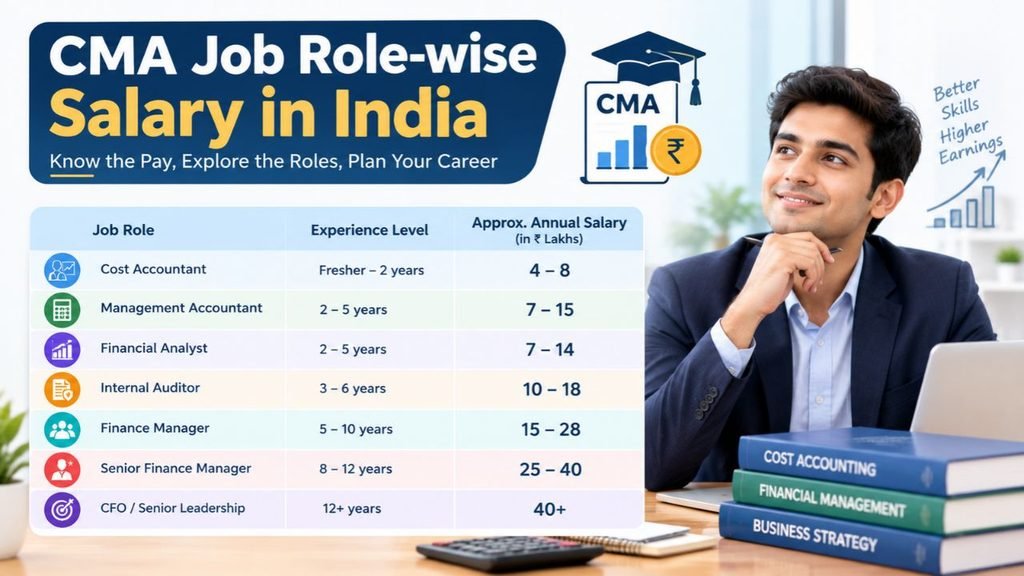
Depending on the position you select, it might have a powerful impact in your income. To begin with, different roles require varying levels of technical skills and business acumen.
1. Cost Accountant
Cost Accountants estimate production costs, analyze operating data and identify ways to maximize the efficiency of operations. At places especially focused on manufacturing and production, they add value.
Entry-level salary could be ₹4-8 lakh a year, and seasoned professionals will earn more after stepping up.
2. Financial Analyst
Financial analysts study financial statements, budgets, business performance and other information related to investments. Their work assists management in delivering accurate financial outcomes.
Bankers, consultants and large corporations will seek professionals who are well-versed at analytics and reporting.
3. Cost Controller
A cost controller keeps an eye on things and compares the actual costs to the budget, if there is a difference between these then they do research. They help businesses manage spending and maintain profit margins.
They can mould the positions into a supervisory and management career paths with an appropriate experience.
4. Financial Planning and Analysis Professional
Professionals working in Financial Planning and Analysis (FP&A) create models, budgets, forecasts and performance reviews. They also collaborate with the business teams to understand revenue, costs, and profitability.
This career path lends itself well if you are experienced with financial modelling, Excel and business intelligence tools.
5. Finance Manager
Finance Managers supervise the financial reporting, budgeting, cash flow, and other financial operations. These positions generally require a considerable amount of experience and usually involve managing teams or business functions.
The extent of the organisation and level of seniority can significantly boost compensation.
The CMA salary in India can vary considerably between cost accountants, financial analysts, cost controllers, and finance managers because their responsibilities differ.
CMA Salary in India by Industry
According to him, entering an industry can have a great impact on salary, career progression, and even day-to-day work responsibilities.
| Industry | Illustrative Annual Salary Range |
| Banking and financial services | ₹6–20 lakh |
| Manufacturing and FMCG | ₹5–18 lakh |
| IT and technology | ₹6–20 lakh |
| Consulting | ₹5–20 lakh |
| Healthcare and pharmaceuticals | ₹5–18 lakh |
| Retail and e-commerce | ₹4–15 lakh |
| Oil, gas, and energy | ₹6–22 lakh |
These ranges represent market estimates based on data available to me and are not average across the industry. And there can be large differences based on employers, job functions, experience and location.
These companies are typically in the manufacturing field, and require a sound understanding of production costs, inventory valuation and cost control. In banks and financial services firms, they may look at the analytical ability for finance or accounting, reporting and risk-relation skills.
Business finance, financial planning and reporting, process improvement positions may be open in technology companies and consulting firms.
Instead of opting for an industry simply because it is as advertised in terms of salary, question whether the work aligns with your interests and long-term aspirations.
CMA Salary in India by City
Salary is also influenced by location since major centres of commerce have a higher density of employers, industries and specialised finance positions.
There are banks and financial institutions, along with various corporate offices in Mumbai. While Bengaluru and Hyderabad have opportunities in tech companies and global capability centres, Delhi NCR is home to consulting firms, multinational companies and corporate finance teams.
Besides Mumbai, you can also pursue career opportunities in manufacturing, services and financial management domain from Chennai, Pune and Kolkata.
While most roles are paid more in major cities, living costs are also a factor. Then maybe a job offering a slightly lower package in an affordable city offers similar standards of living.
Think about total compensation, cost of living, commuting costs and opportunities for advancement when comparing locations instead of just the headline salary.
Indian CMA vs US CMA Salary in India
Display the user avatar Users Lastly, consider your qualification – During deciding between Indian CMA and US CMA this is the commonly asked question by students.
The Indian CMA is awarded by the ICMAI and the U.S. CMA is awarded by Institute of Management Accountants.
| Factor | Indian CMA | US CMA |
| Awarding body | ICMAI | IMA, USA |
| Main focus | Cost and management accountancy | Management accounting and financial management |
| Common opportunities | Costing, management accounting, corporate finance | FP&A, corporate finance, management accounting |
| Career market | Strong relevance in India | Opportunities with Indian and multinational employers |
| Salary | Depends on role and experience | Depends on role, experience, and employer |
The salary effects of these qualifications are not directly comparable because the available salary data can refer to various employers, job roles, and candidate groups.
No specific salary is guaranteed for either qualification. You still need technical skills, professional experience, comms, and ability to solve business problems.
Ways to Boost Your Income as a CMA

Probably every non-executive career is (more or less) a professional qualification, but continuous education will help you get more competitive opportunities.
Practical guidelines to boost your career potential.
Develop advanced Excel skills. How to use formulas, PivotTables and financial modelling, data analysis techniques.
Understand ERP software. Cost accounting, reporting and finance operations could involve an understanding of systems like SAP.
Improve communication skills. Accountants often describe budgets, expenses and company performance to teams who may not be versed in finance.
Gain practical experience. Internships, training and prior job experience will help you gain in-depth understanding of how theoretical concepts directly relate to business real-world scenarios.
Learn financial analytics. Use Power BI and other reporting tools that can show you finance in different ways.
Build industry knowledge. Grasp the basic mechanics about how an industry makes the revenue and manages costs, such as manufacturing, banking system, information technology etc; in order to get directly useful endpoints from your analysis.
Take ownership of projects. In fact, those who will enhance reporting processes, minimize wasteful spending and/or facilitate better business decisions may emerge as more promoted roles.
Salary increase is almost always a combination of greater experience, better performance and more responsibility. Professionals who develop advanced Excel, ERP, financial modelling, and analytical skills may improve their chances of securing a higher CMA salary in India over time.
Is CMA a Good Career Choice in India?
CMA can be a good profession for students who aspire to study accounting, finance, strategy and analytical skills or even business management.
This qualification can take you into the fields of costing, budgeting, financial analysis, internal controls, and management accounting as well as corporate finance.
But it is not easy to prepare for the course, and getting through it does not mean you will land a high-paying job after it’s finished. Today, we will share what aspirants need to think while considering law courses with regard to subject interest, examination dedication, availability for practical training, and the preferred future career.
Actual job openings and ICMAI placement statistics are also helpful to learn what employers expect from you today.
CMA can lay a strong foundation for a fulfilling professional career if you have an interest in financial information as well as helping entities make decisions effectively.
Also Read: Biotechnology Salary | Google CEO Salary | Deloitte Consultant Salary | Cabin Crew Salary
Conclusion
More importantly, the CMA salary in India is reliant on an extremely large number of components other than just capability. Your earning potential depends on your experience, industry, employer, location, technical skills, and job performance.
Freshers can start from entry-level costing or finance jobs and travel up toward financial analysis, cost management, finance management & senior leadership positions. Some get campus offers that are above-average for their field, but those numbers should not be interpreted as starting salaries to aspire to.
If you are looking to opt for CMA, you will have to build your foundation in accounting well, work practically, and acquire analytical as well as communication skills. These steps can aid you in preparing for the right opportunities and eventually establishing a long-term career in finance and management accounting.
FAQs About CMA Salary in India
1. How much does CMA make per month?
Incomes per month is directly dependent on annual compensation. ₹50,000 a month translates to an annual package of ₹6 lakh in gross CTC terms that excludes deductions and even benefits.
2. Is it possible to earn 1 lakh per month as a CMA?
Yes. A ₹12 lakh CTC package translates to a pre-tax gross pay of ₹1 lakh a month. Achieving this level will depend on the role, employer and experience.
3. Does CMA pay scale increase with experience?
Generally, yes. While experience can serve to qualify professionals for more specialised roles and larger responsibilities, salary growth is not assured.
4. What is the difference between Indian CMA and US CMA?
Yes. ICMAI awards the Indian CMA and while IMA (in the USA) grants US CMA. Their qualification and career pathways look different.
5. Can a CMA become a CFO?
Yes. With the right experience, leadership abilities, and business insight/a CMA may even advance to senior finance leadership positions like CFO.