





By Chad Holloway
A baccarat probability calculator helps explain the math behind baccarat. It shows how often Banker, Player, and Tie results can happen. It can also show how payouts affect the expected return and how commission changes the value of a bet. This is useful whether someone is studying traditional baccarat or watching live baccarat online, where real cards are dealt by a dealer while bets and results are handled through a digital interface. The format may look different, but the basic math stays the same. Every bet has a chance of winning, a set payout, and a long-term expected result. A calculator cannot predict which side will win the next hand. Instead, it helps explain the odds, payouts, house edge, and expected value based on the game rules.
What Is a Baccarat Probability Calculator?
A baccarat probability calculator estimates or displays the mathematical chances associated with different baccarat outcomes. The three main outcomes are Banker, Player, and Tie, but more advanced tools may also account for the number of decks, commission, table variants, side bets, and alternative payout structures. The main value of such a calculator is that it separates several concepts that are often confused. Probability tells you how often an event is expected to happen. Payout shows how much a winning wager returns. House edge describes the casino’s theoretical advantage over a very large number of bets. Expected value combines the chance of winning with the amount won or lost. For example, a calculator may show that Banker wins slightly more often than Player under standard baccarat rules. It can then factor in the usual commission and show how this changes the effective return.
Probability Calculator vs Baccarat Payout Calculator
A probability calculator and a payout calculator do different jobs. A probability calculator shows how likely each result is, such as Banker, Player, or Tie. A payout calculator starts with the bet amount and payout rules. It then shows the profit, commission, and total return. Some baccarat tools combine both features. For example, they can show the chance of a Banker win and then calculate how a 5% commission affects a $100 bet.
Basic Baccarat Probabilities and How They Compare With Super Sic Bo Live

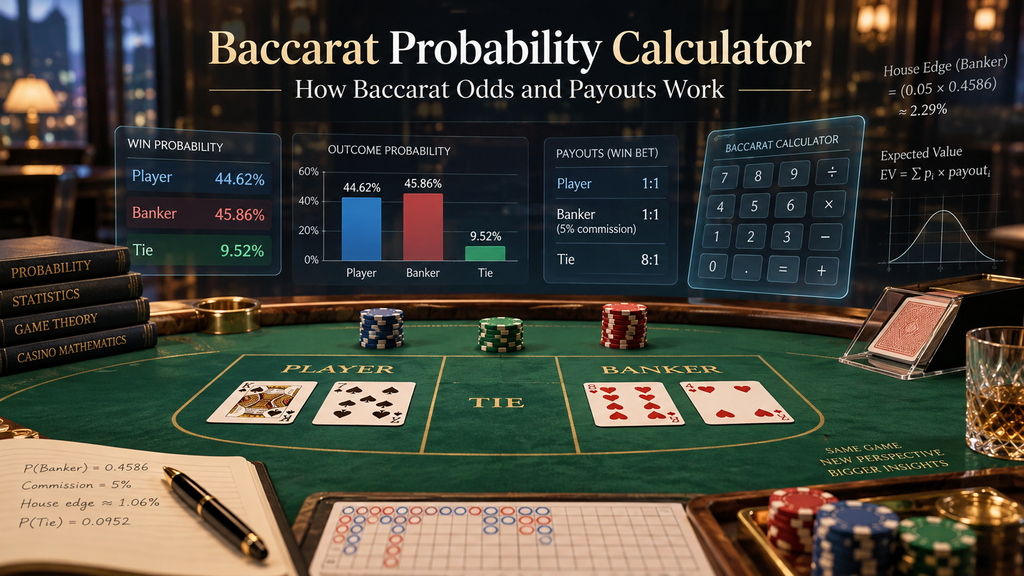
Standard baccarat odds come from fixed rules for the Player and Banker hands. In a typical eight-deck game, Banker wins about 45.86% of all hands. Player wins about 44.62%, while Tie happens around 9.52% of the time. This means Banker has a small advantage over Player. However, Banker still wins less than half of all hands when ties are included. The mathematical structure is quite different from games such as super sic bo live, where probabilities are based on combinations of three dice rather than card-drawing rules. In baccarat, the result depends on card values, the initial two-card totals, and whether Player or Banker must draw a third card.
Why Banker Wins Slightly More Often
Banker and Player do not follow exactly the same drawing rules. The Player rule is relatively simple, while the Banker rule is more complex and can depend on both the Banker’s total and the value of the Player’s third card. These rules create a small statistical advantage for Banker. That is why standard baccarat usually applies commission to Banker wins. A common rate is 5%, although some baccarat variants use different systems.
Why Tie Probability Is Much Lower
A Tie requires both hands to finish with the same total. This naturally happens less often than one side finishing ahead of the other. The Tie bet therefore pays much more than the main Banker or Player bets. However, a larger payout does not automatically mean better mathematical value. The probability of the event and the amount paid must always be considered together.
How to Use a Baccarat Probability Calculator
A baccarat calculator works best when its settings match the real table rules. First, choose the baccarat version and select Banker, Player, or Tie. If needed, enter the bet amount to calculate the payout. The calculator can then apply the correct commission, payout rate, and other rules. It may show the odds, possible profit, total return, house edge, or expected value. The settings must match the table exactly. For example, if a Tie pays 9:1 at the table but the calculator uses 8:1, the result will not be accurate.
What Information Matters Most?
The main inputs are usually the bet, payout rules, and baccarat version. Some calculators also let you change the number of decks, Banker commission, side-bet payouts, or no-commission rules. Not every calculator needs all of these settings. For a simple comparison of Banker, Player, and Tie, standard settings may be enough. For a more detailed result, the exact game rules are more important.
How to Read the Results
The result screen may show several numbers, and each one means something different. Win probability shows how often an outcome is expected to happen. Net profit is the money won after commission, without counting the original stake. Total return includes both the stake and the profit. House edge shows the casino’s long-term mathematical advantage. Expected value shows the average result of making the same bet many times. These numbers are important because two bets can have similar chances of winning but very different payouts and long-term results.
Banker, Player, and Tie Odds Compared
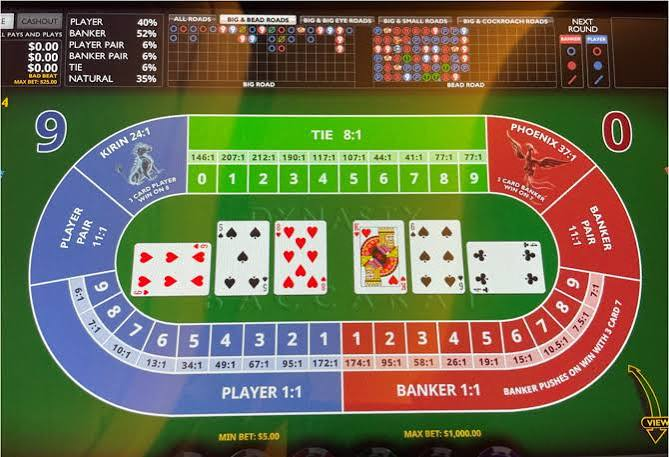
The three main baccarat bets do not have the same odds. In a common eight-deck game, Banker wins about 45.86% of hands. Its house edge is around 1.06% after the usual commission. The player wins about 44.62% of hands and has a house edge of about 1.24%. A Tie happens about 9.52% of the time. Even with an 8:1 payout, the Tie bet can have a house edge of around 14.36%. This shows why a bigger payout does not always mean a better bet.
Why Probability and House Edge Are Not the Same
Probability tells us how often an event is expected to happen. House edge tells us how much of each bet the casino expects to keep on average over many bets. These ideas are connected, but they are not the same. A rare event can still offer fair value if the payout is high enough. In the same way, a large payout may still be poor value if the chance of winning it is very low.
How Baccarat Probability Is Calculated
At the simplest level, probability can be written as:
Probability = favorable outcomes ÷ total possible outcomes
Baccarat is more complicated because every hand can involve several cards and conditional drawing rules. A full calculation has to account for initial card combinations, possible third cards, card values, Player drawing rules, Banker drawing rules, and Tie outcomes. This creates a very large number of possible sequences.
Why Computer Calculation Is Useful
Manual calculations can be difficult because the Banker’s third-card rule changes based on both hands. A computer can check every valid outcome and count how often each result happens. This makes probability calculators useful for explaining baccarat math without doing complex calculations by hand.
Does the Number of Decks Change Baccarat Odds?
Yes, but the difference is usually small in common multi-deck baccarat games. A single-deck game has slightly different odds from a six-deck or eight-deck game because every removed card changes the cards left in the shoe. This effect becomes smaller when more decks are used. In most baccarat games, the number of decks matters less than the choice between Banker, Player, Tie, or different table rules.
Baccarat Payout Calculations
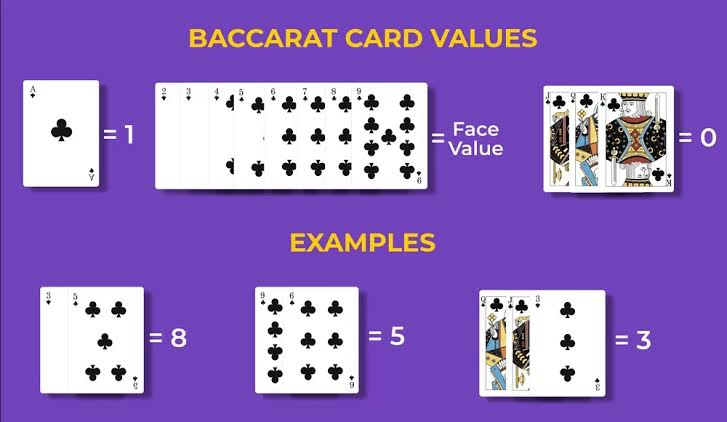
Baccarat payouts are easier to calculate than exact odds because they usually follow fixed paytables. A Player win normally pays 1:1. For example, a $100 winning Player bet gives $100 in profit, plus the original $100 stake back. Banker bets use a similar payout, but a standard commission usually reduces the final profit.
Player Bet Payout
A standard Player wager pays even money. If the stake is $50 and Player wins, the profit is $50 and the total amount returned is $100. If the hand ends in a Tie, the normal Player wager is usually treated as a push and the original stake is returned.
Banker Bet and 5% Commission
A standard Banker wager also starts with an even-money payout, but a 5% commission is commonly deducted from the winnings. For a $100 wager, the gross profit is $100. A 5% commission removes $5, leaving a net profit of $95. Together with the original stake, the total return is $195. The commission exists because Banker wins slightly more often under standard drawing rules.
Tie Bet Payouts
Tie bets usually pay 8:1 or 9:1, depending on the table. For example, a $10 Tie bet at 8:1 gives $80 in profit and $90 back in total. The payout is much higher than on Banker or Player bets. However, a Tie is also much less likely to happen. For this reason, the payout should always be compared with the probability and house edge.
Understanding House Edge With a Baccarat Calculator
House edge describes the long-term mathematical advantage built into a casino wager. It does not predict what will happen in a single session or on the next hand. A player can win or lose far more than the theoretical average over a short period. Under standard eight-deck rules, Banker usually has the lowest house edge of the three main bets at roughly 1.06%. Player is slightly higher at around 1.24%. Tie is much higher when the payout is 8:1.
Banker House Edge
The Banker bet wins slightly more often because of the game’s drawing rules. However, the standard commission lowers the payout. This keeps a small house edge. So, even though Banker wins more often than Player, it still has a negative expected return over time.
Player House Edge
Player avoids commission, but its probability of winning is slightly lower. The result is a somewhat higher house edge than Banker under standard rules.
Tie House Edge
The Tie bet illustrates why large payouts can be misleading. Even with an 8:1 payout, a Tie is still unlikely. Because of this, the house edge is much higher than on Banker or Player bets.
Expected Value in Baccarat
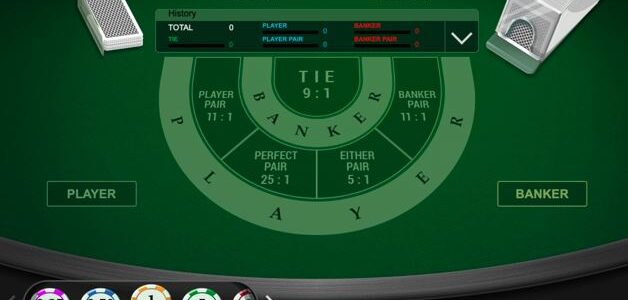
Expected value, usually shortened to EV, combines the probability of each result with the financial outcome.
A simplified formula is:
EV = (probability of win × amount won) − (probability of loss × amount lost)
Pushes can also be included where relevant.
Positive and Negative Expected Value
Positive expected value means a bet could make a profit on average over many repeated wagers. Negative expected value means the average result is a loss over time. Standard baccarat bets usually have negative expected value because the house has a built-in advantage. This does not mean every bet will lose. Some bets can win. However, over a very large number of bets, the average result tends to move closer to the expected mathematical outcome.
Why EV Does Not Predict a Session
Expected value should not be confused with a guaranteed result. A wager with an average theoretical loss of $1 per $100 staked can still win $100 on one hand and lose $100 on the next. EV becomes meaningful over many repetitions, not as a forecast of a single round or short session.
Standard Baccarat vs No-Commission Baccarat
Not every baccarat table uses the standard 5% Banker commission. Some variants remove the commission but compensate by changing another payout rule.
Standard Baccarat
In the traditional format, Banker effectively pays 0.95:1 after commission, while Player usually pays 1:1. Tie payouts vary, but 8:1 and 9:1 are common. This is the model used by many basic baccarat probability and payout calculators.
Super 6 / No-Commission Baccarat
Super 6 typically removes the normal Banker commission. Instead, certain Banker wins receive a reduced payout. A common rule is that a Banker winning with a total of 6 pays only 0.5:1. For example, a $100 Banker wager that wins with 6 may return only $50 in profit rather than $100. This changes both the payout calculation and the house edge.
EZ Baccarat
EZ Baccarat also removes the usual Banker commission, but it uses a different rule. If the Banker wins with a three-card total of 7, the result is a push. This changes how some Banker wins are paid and affects the expected return. Because of this, a baccarat calculator needs a separate EZ Baccarat setting. Simply removing the commission from standard baccarat is not enough.
How Table Rules Change Calculator Results
Two baccarat games can have the same name but different odds. The number of decks, Tie payout, Banker commission, and special rules can all change the expected return. This is especially important in no-commission baccarat. No visible commission does not mean the house edge is gone. In most cases, the advantage is simply built into another rule or payout. A good baccarat calculator should clearly show which rules it uses.
Baccarat Side Bet Probability
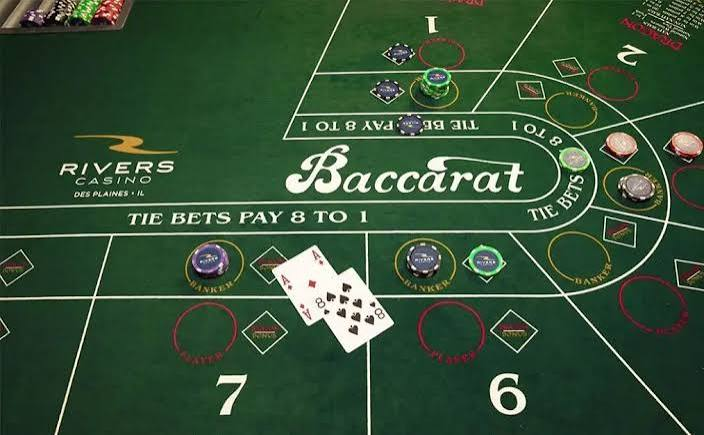
Modern baccarat tables may also offer side bets such as Player Pair, Banker Pair, Perfect Pair, Dragon 7, or Panda 8. These bets use different rules and outcomes. Because of that, they cannot be calculated with the standard Banker, Player, and Tie probabilities.
Why Side Bets Need Separate Calculations
A Pair bet wins when the first two cards have the same rank. Dragon 7 depends on a specific Banker result. Panda 8 depends on a specific Player result. Each side bet has its own odds and payout rules. Because of this, each one needs a separate expected-value calculation. A calculator that covers only Banker, Player, and Tie bets may not give accurate results for every side bet.
Can a Baccarat Calculator Predict the Next Hand?
No. A baccarat probability calculator describes mathematical likelihood. It does not provide reliable knowledge of the next specific result. If Banker has won several hands in a row, the calculator cannot conclude that Player must be next. The same is true in the opposite direction.
The Gambler’s Fallacy
The gambler’s fallacy is the idea that a streak makes the opposite result more likely. For example, after five Banker wins, someone may think Player is now due to win. But previous results alone do not support this idea. Baccarat uses a limited number of cards, so removing cards can slightly change the exact odds. However, a streak of Banker or Player wins does not give enough information to predict the next hand.
Probability vs Prediction
Probability describes uncertainty. Prediction claims that a particular outcome will happen. A legitimate baccarat calculator should do the first, not the second. If a tool claims it can reliably identify the next winning hand from recent Banker and Player results, that should be treated with caution.
Do Previous Baccarat Results Affect Probability?
This is a little more complex than it seems. Baccarat uses a limited number of cards in the shoe. As cards are dealt, the cards left in the shoe change. This can slightly change the odds of the next hand. However, a result history such as Banker, Banker, Player, Tie does not show which cards were used. Because of this, past results alone are not enough to calculate the exact odds of the next hand. To do that, you would need to know which cards are still left in the shoe.
Example Baccarat Calculator Calculations
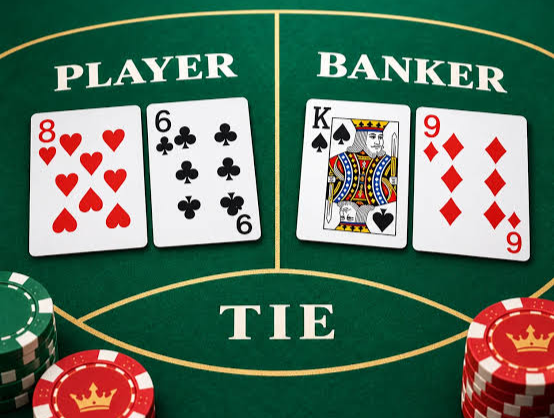
A standard $200 Banker bet with a 5% commission gives $200 in gross profit if it wins. The $10 commission reduces the net profit to $190, so the total return is $390 including the original stake. A $200 Player bet pays 1:1, so a win gives $200 profit and a $400 total return. A $20 Tie bet paying 8:1 gives $160 profit and a $180 total return if it wins. The Tie payout is much higher, but the chance of winning is much lower. This is why payouts should always be compared with the odds and house edge.
Common Baccarat Probability Mistakes
A common mistake is thinking that Banker wins more than 50% of all hands. This is not true when ties are included. Another mistake is judging bets only by their payout. A high payout can still come with a high house edge. Players may also forget to include commission when checking Banker returns. They may also assume that all no-commission tables have the same rules. Streaks can also be misleading. A long run of Banker or Player wins does not mean the other side must win next. Finally, the house edge does not mean a player will lose that exact amount in a short session. It is a long-term mathematical average.
What a Good Baccarat Probability Calculator Should Show
A useful calculator should clearly show how it gets its results. It should list the baccarat version, number of decks, payout rate, and commission rules. It should also explain the difference between win probability, net profit, total return, house edge, and expected value. Most importantly, it should explain what the numbers mean. Probability should not be presented as a prediction of what will happen next.
FAQ About Baccarat Probability Calculators
- What Is the Probability of Banker Winning in Baccarat?
In a common eight-deck game, Banker wins approximately 45.86% of all hands when ties are included.
- What Is the Probability of Player Winning?
Player wins around 44.62% of hands under standard eight-deck rules.
- How Often Does a Tie Occur?
A Tie occurs in roughly 9.52% of standard eight-deck baccarat hands.
- Why Does Banker Pay Commission?
Banker wins slightly more often because of its drawing rules. The standard commission reduces the payout to offset this mathematical advantage.
- Does Banker Have More Than a 50% Chance of Winning?
Not when ties are included. If ties are removed and only Banker and Player decisions are counted, Banker represents slightly more than half of resolved outcomes.
- Can a Baccarat Calculator Predict the Next Hand?
No. It can calculate probabilities and expected values, but it cannot reliably predict a specific future hand.
- What Is the House Edge on Banker?
Under common eight-deck rules with a 5% commission, the Banker house edge is approximately 1.06%.
- Does the Number of Decks Change Baccarat Probability?
Yes. Exact probabilities vary slightly depending on the number of decks, although the differences between common multi-deck formats are relatively small.
- Do Super 6 and EZ Baccarat Have Different Odds?
Yes. Both modify the normal Banker payout rules, so their house edges and expected values differ from standard baccarat.
Conclusion
A baccarat probability calculator is a tool for understanding the math behind the game. It can show how often Banker, Player, and Tie results occur. It can also explain how commissions affect returns and why a more likely result does not always have the lowest house edge. The key point is that probability is not the same as prediction. Baccarat odds can be calculated under set rules, but they cannot tell you what the next hand will be. The rules also matter. Standard baccarat, Super 6, EZ Baccarat, different Tie payouts, side bets, and deck counts can all change the numbers. A useful calculator should therefore show more than a percentage. It should explain the rules used and clearly separate probability, payout, expected value, and house edge.