





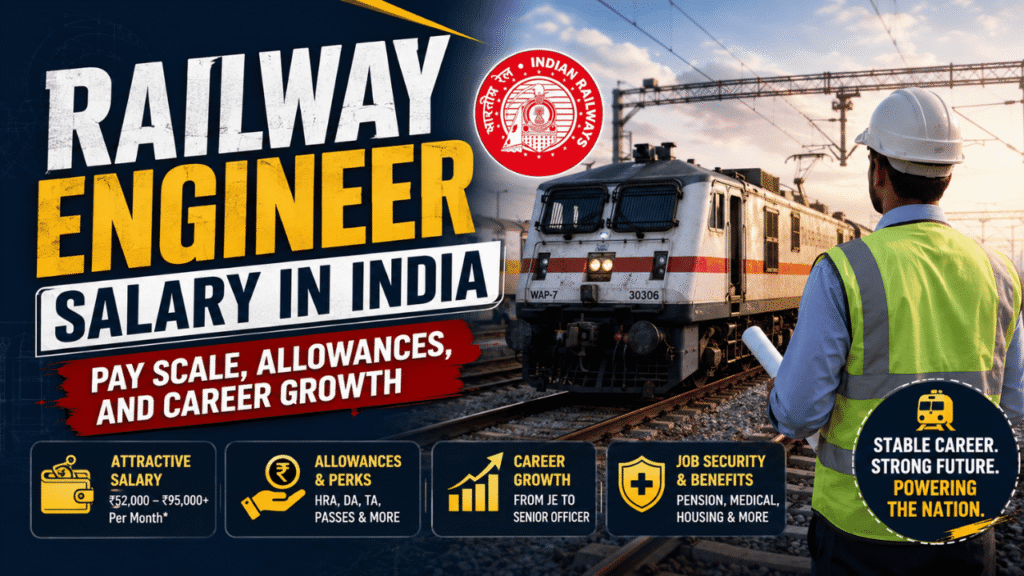
In India, one of the most preferred career options for engineers and diploma holders is with Indian Railways (and for good reason). Apart from the prestige of working for the country’s top employer of engineers, a railway engineer salary package offers strong base pay along with an unusually large set of allowances, perks, and career-long benefits that most private sector jobs can’t manage. In this article, we are specifically covering everything you need to know about Railway Engineer salary in India, starting from the ground-level Junior Engineer posts till senior officer ranks, with well-detailed allowances, in-hand data, and the promotion scheme that defines what your earning through out your career.
Railway Engineer Salary in India: A Brief Overview
The salary of a Railway Engineer in India depends on the post and experience level as well as the city posted. At the entry-level, a Junior Engineer appointed through the Railway Recruitment Board (RRB) will get a basic pay of ₹35,400 per month in Pay Level 6 as per the 7th Central Pay Commission. The gross monthly figure generally increases significantly once allowances are included.
The salary of a railway engineer typically ranges from approximately ₹4.5 lakh per annum for a junior role at the start of your career to about ₹16-18 lakh per annum by senior engineer and officer-level positions, depending on various parameters like grade, department, and years of service.
Railway Engineer Salary Structure: Component Breakdown
| Component | Details |
| Basic Pay (JE) | ₹35,400 per month (Level 6) |
| Grade Pay (JE) | ₹4,200 |
| Basic Pay (SSE) | ₹44,900 per month (Level 7) |
| Dearness Allowance | Revised periodically as a percentage of basic pay |
| HRA (Class A / Tier I) | 24% of basic pay |
| HRA (Class B / Tier II) | 18% of basic pay |
| Transport Allowance (Tier I) | ₹3,600 + DA on TA |
| Transport Allowance (Tier II) | ₹1,800 + DA on TA |
| Gross Salary (JE) | ₹52,000 – ₹66,000 per month |
| In-Hand Salary (JE) | ₹51,000 – ₹61,000 per month |
Entry Level: RRB JE Salary
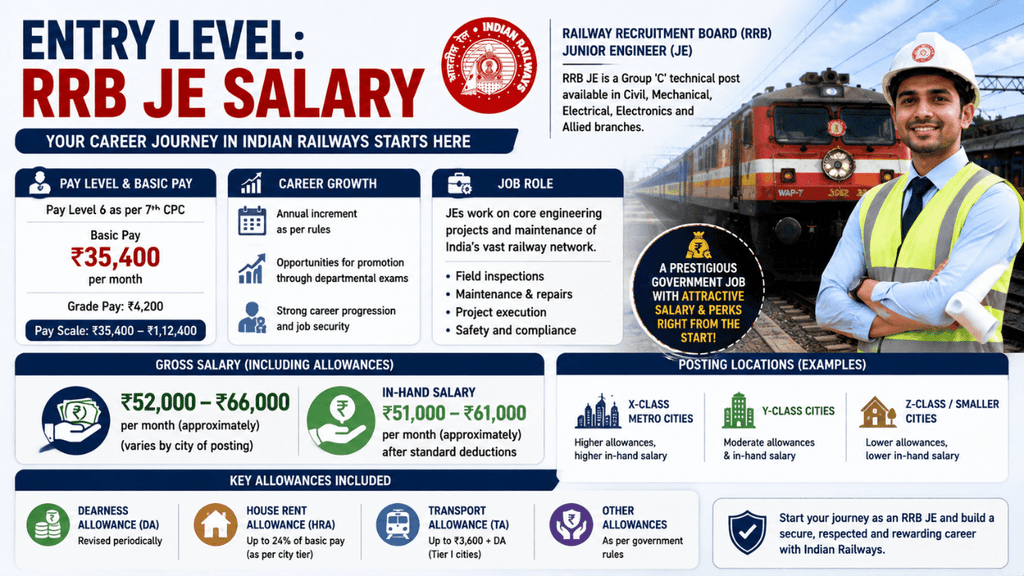
This is the most common technical post to start a career in the railway engineering field & Group ‘C’ level. Job posts are available in the fields of Civil, Mechanical, Electrical, Electronics, and Allied branches.
All the notified RRB JE posts are at Pay Level 6 in the 7th CPC Pay Matrix, combined with basic pay of ₹35,400 per month and Grade Pay of ₹4,200. The pay scale for the level ranges between ₹35,400 and ₹1,12,400 as one moves from one grade to another over the years on annual increments.
Significantly, basic pay is only one part of the equation. The gross railway engineer salary at JE level adds Dearness Allowance, House Rent Allowance and Transport Allowance to reach between ₹52,000 to in-city (depending on the city of posting) between ₹66,000 per month.
Railway JE In-Hand Salary
The in-hand salary of a Railway JE after standard deductions like NPS contribution and professional tax generally varies between ₹51,000 to 61,000 per month as per posting location. While in X-class metro cities such as Delhi or Mumbai, the in-hand pay is usually between ₹57,000 and ₹61,000; in smaller Z-class cities, this generally amounts to about ₹51,000 to ₹55,000 post-deductions.
Railway JE Salary: Gross vs In-Hand
| Posting Type | Basic Pay | Approx. Gross Salary | Approx. In-Hand Salary |
| X-Class / Metro City | ₹35,400 | ₹60,000-₹66,000 | ₹57,000-₹61,000 |
| Y-Class City | ₹35,400 | ₹55,000-₹60,000 | ₹54,000-₹58,000 |
| Z-Class / Smaller City | ₹35,400 | ₹52,000-₹56,000 | ₹51,000-₹55,000 |
Also Read: Railway Staion Master Salary | RRB Group D Salary | Loco Pilot Salary | Deputy Collector Salary
Senior Section Engineer (SSE) Salary
Once, they work as Junior Engineer for a specified number of years, clearing internal departmental exams for promotion to Senior Section Engineer, which is a supervisory post and involves considerably more responsibility (and pay).
At Level 7 of the 7CPC, the SSE post enjoys a basic pay of ₹44,900, signifying a leap in pay of almost ₹9,500 over the JE basic pay. The gross salary of a railway engineer within 10 years of service who is promoted to SSE (Senior Section Engineer) level after the probation period ranges from ₹80,000 to ₹95,000 per month, including allowances, whereas in-hand pay works out to around ₹65,000-₹80,000 depending upon location and deductions.
SSEs are one of the operational backbones for Indian Railways infrastructure. All 18 zonal railways house an estimated total of 50,000 to 60,000 SSEs responsible for a wide range of jobs including track and P-Way maintenance; electric locomotive rehabilitation; signalling systems; overhead electrical wiring, while each department maintains its own SSE cadre at equal pay scales but widely varied work profiles.
Officer-Level and Higher Posts
Outside of the supervisory line, engineers could move onward to officer positions. For example, the pay scale of Assistant Divisional Engineer (ADE) is between ₹50,000 and ₹1.6 lakh – Levels 8 to 10 under the 7th CPC.
Engineers can also join Indian Railways directly at officer ranks after clearing the UPSC-held Engineering Services Examination (ESE), currently a much quicker way to senior responsibilities and, therefore, a higher railway engineer salary right from level one.
Railway Engineer Salary by Post
| Post | Pay Level | Basic Pay | Approx. Gross Salary | Approx. In-Hand Salary |
| Junior Engineer (JE) | Level 6 | ₹35,400 | ₹52,000–₹66,000 | ₹51,000–₹61,000 |
| Senior Section Engineer (SSE) | Level 7 | ₹44,900 | ₹80,000–₹95,000 | ₹65,000–₹80,000 |
| Assistant Divisional Engineer | Levels 8–10 | ₹50,000+ | Varies by level | Varies by posting |
| Divisional Engineer & Above | Higher Levels | Varies | Varies | Varies |
Facilitating and Additional Advantages Other Than Basic Salary
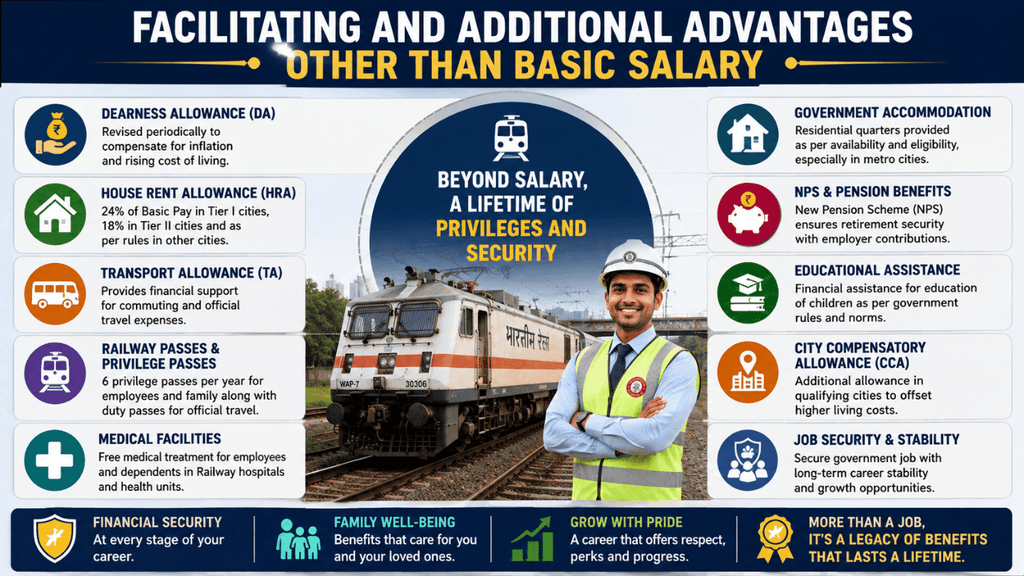
A large reason why the railway engineer package compares so well with private sector alternatives is the wide breadth of allowances and extra cash benefits associated with it.
Dearness Allowance (DA) is increased periodically to compensate for inflation and generally constitutes a significant portion of monthly income, increasing steadily throughout an employee’s career.
House Rent Allowance (HRA) can range from 24% of Basic in Tier I cities and can go as low as in case of mother towns.
Transport Allowance (TA) is for travel expenses, with higher allowances in metro postings.
Railway Duty Passes and Privilege Pass are the most unique benefits of a railway profession. Engineers usually get six privilege passes a year for themselves and their families, besides duty passes for work-related travel. This benefit alone can range up to ₹50,000 – ₹1,00,000 a year depending on one’s travel habits.
Medical facilities through railway hospitals and health units extend to employees in addition to dependents, thus minimizing out-of-pocket medical expenses to a very desirable degree.
Government housing (as available) is also a big plus, especially in high-cost metro posts.
NPS pension benefits, educational assistance for children, and City Compensatory Allowance in qualifying locations are added.
Altogether, these benefits usually contribute between 30% and 50% of the value on top of basic pay, making it difficult to compare a typical railway engineer salary with an equivalent private-sector CTC figure at all fairly.
Factors Affecting the Salary of a Railway Engineer
Where someone lands in the railway engineer salary spectrum depends on several factors:
Experience and seniority – the single most significant one, with consistent level jumps annually by increments and department sitting.
Location of Posting – While HRA and transport allowances differ significantly between the two locations, it creates a sizable difference in gross pay for a similar position across metro cities vs smaller towns.
Department and specialisation – all engineering departments pay equally, but if you have specific skills in certain areas like signal and telecom, track maintenance, electrical systems, then that plays a role in career path and chances of internal locomotion.
Entry route – engineers entering through the ESE officer route have pay scales significantly higher than RRB JE hiring.
The 8th Pay Commission Factor
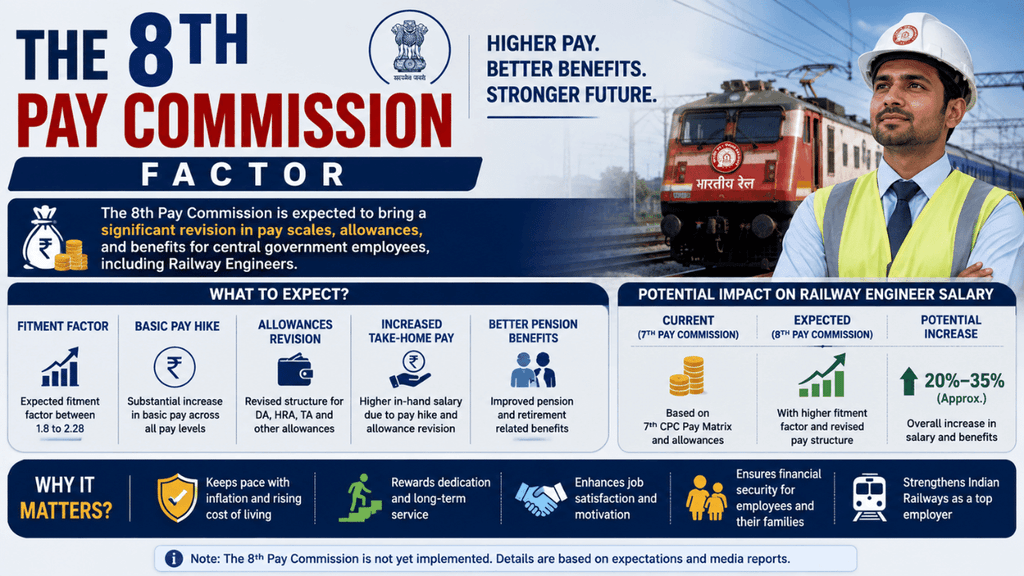
The implementation of the 8th Pay Commission in Indian Railways is likely to change pay for railway staff, including engineers. Though the pay matrix and revised allowance structure are not yet officially released, aspirants would expect a significant hike as a result of a higher fitment factor through revised pay scales. For someone considering a career in railway engineering, Page 7st CPC salary structure is well-informed that these figures are likely to increase when the new commission comes into effect.
Career Growth Path
This is typically how a railway engineer entering through the RRB JE route progresses through their career.
Railway Engineer Career Progression and Pay Levels
| Career Stage | Position | Pay Level | Main Responsibility |
| Entry Level | Junior Engineer (JE) | Level 6 | Technical and field-level engineering work |
| Supervisory Level | Senior Section Engineer (SSE) | Level 7 | Supervising teams and technical operations |
| Officer Level | Assistant Divisional Engineer | Levels 8–10 | Engineering management and divisional responsibilities |
| Senior Management | Divisional Engineer & Above | Higher Levels | Senior administration, planning, and management |
In many private sector alternatives, the career path is much more nebulous; but promotions depend on a combination of years in service, performance, and success at internal examinations, which fleshes out a structured place in the pyramidised world that is banking.
Also Read: DSP Salary | 8th Pay Commission Salary Hike | Lekhpal Salary | CGDA Auditor
Conclusion
A railway engineer salary in India offers you a really good Consolidation of Regular and Predictable payment with an exceptionally generous Benefits Package. The salary of Junior Engineers starts from ₹35,400 and goes much higher into six figures monthly at senior levels.
Incorporating elements such as free travel passes, medical care and protection of federal homes, along with pension benefits, implies a railway engineer might be really worth well over the large headline-striking profits figure. For engineers looking for steady jobs with a structured growth path, Indian Railways is still one of the most attractive career paths, especially when long-term security outweighs immediate hikes in pay.
FAQs About Railway Engineer Salary
1. What is the starting salary of a railway engineer in India?
RRB JE has a basic pay of ₹35400 per month with a gross pay of approximately ₹52,000-₹66,000.
2. How much is the Railway JE in-hand salary?
Location-wise, it usually varies between ₹51,000 and ₹61,000/month.
3. How to become a Railways Engineer in India?
For entry-level positions, you can go in via the RRB JE exam, or for the officer-level roles, the UPSC Engineering Services Examination.
4. Is there a rise in Railway Engineer Salary after the 8th Pay Commission?
If, of course, salaries are expected to change, the pay structure is yet to be officially launched.
5. What are the allowances offered under railway engineer salary?
DA, HRA, TA, medical facilities, travel passes, and other applicable allowances are some of the major benefits.