






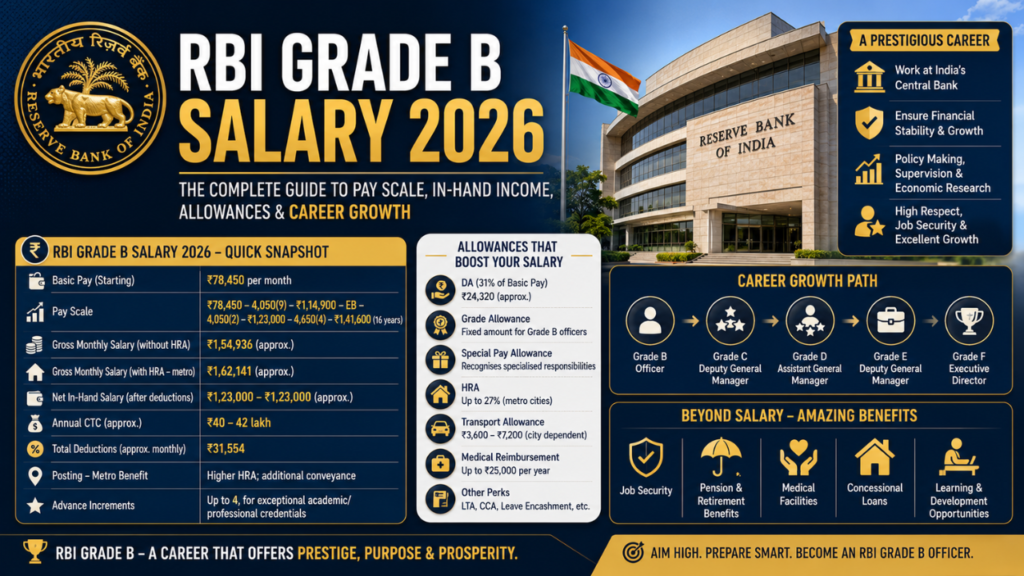
Ask any serious aspirant for banking exams what their dream job is like, and a very big chunk of those aspirants will mention the Reserve Bank of India in one of the forms. The prestige is well-founded – here lies the country’s central bank, the top institution of India’s financial system, responsible for monetary policy and issuance of currency along with regulations of banks and the overall health of the economy. However, all prestige does: it neither pays the rent nor builds the wealth.
One of the main reasons why the RBI Grade B salary is always an uppermost topic among candidates preparing for competitive exams is that it is indeed one of the best pay scales not just in the Indian government sector but Public Sector Undertakings (PSUs) as well.
The RBI Grade B Notification is released in April with 60 vacancies every year for General, DEPR and DSIM streams, followed by the exam in June or July, so candidates appearing for it need to have a clear and honest picture of the actual package behind all that smoke – from basic pay to gross salary to absolute earning per month take-home and the complete list of allowances. This guide covers every component.
What is an RBI Grade B Officer?
Before the numbers, the context. RBI Grade B is a managerial position for officers in Grade B (General) – DR, DEPR, and DSIM under the Common Seniority Group. They are responsible for ensuring the smooth functioning of member banks under Reserve Bank of India.
You will be neither a bank teller nor a branch manager of any commercial bank, as the job of an officer in Grade B. One of the key professionals in a bank who crosses paths with regulators and policymakers, whether you like it or not. It entails banking supervision, monetary policy analysis, currency management, regulatory compliance, and economic research – depending on your stream. Intellectual acumen is also a prerequisite of the job, which explains why securing one becomes one of the toughest selection processes for any government position in India and therefore its salary structure.
RBI Grade B Salary 2026: Quick Snapshot
| Component | Amount |
| Basic Pay (Starting) | ₹78,450 per month |
| Pay Scale | ₹78,450 – 4,050(9) – ₹1,14,900 – EB – 4,050(2) – ₹1,23,000 – 4,650(4) – ₹1,41,600 (16 years) |
| Gross Monthly Salary (without HRA) | ₹1,54,936 (approx.) |
| Gross Monthly Salary (with HRA – metro) | ₹1,62,141 (approx.) |
| Net In-Hand Salary (after deductions) | ₹1,23,000 – ₹1,32,000 (approx.) |
| Annual CTC (approx.) | ₹40-42 lakh |
| Total Deductions (approx. monthly) | ₹31,554 |
| Posting – Metro Benefit | Higher HRA; additional conveyance |
| Advance Increments | Up to 4, for exceptional academic/professional credentials |
The Payscale structure and Basic Pay
An RBI Grade B officer starts with a basic pay of ₹78,450 per month. The new pay matrix is ₹78,450 – 4,050(9) – ₹1,14,900 – EB – 4,050(2) – ₹1,23,000 – 4,650(4) over a period of 16 years.
This notation indicates the complete incremental trajectory. Breaking it down:
- Starting basic pay: ₹78,450
- Basic pay after 9 yearly hikes of ₹4,050: ₹1,14,900
- Efficiency Bar (EB): A performance-linked checkpoint preceding the next stage
- Basic pay becomes ₹1,23,000 after 2 further increments of ₹4,050
The basic pay reaches ₹1,41,600 at the tail end of the 16-year cycle follows four more increments of ₹4,650:
This can raise the basic pay to ₹1,41,600 without a promotion. This gradual increase in wage promises financial development as well as work fulfillment over time.
That final point matters enormously. This means that from structured increments alone, the basic pay of a Grade B officer with no promotions over 16 years rises by almost double. Sure, basic pay gets automatically compounded; add a little to that, and the DA, HRA, and other allowances linked to basic pay get an automatic cascade effect, making a look at lifetime earnings actually very attractive compared to the base number.
Additional bonus provision: For candidates with exceptionally high qualifications or experience of great value to the Bank, at its sole discretion, the Bank may consider granting up to four advance increments. This means the starting basic pay for an exceptionally qualified candidate could be higher than ₹78,450 and join on almost ₹94,650 from day 1.
Also Read: IB Security Assistant Salary | Income Tax Officer Salary
Allowances to Create the Complete Package
And base pay is only half the equation. The RBI Grade B salary is based on a structure of numerous allowances that together increase the monthly earning by some tens of thousands of rupees.
Dearness Allowance (DA)
DA is 31 percent of Basic Pay as per 7th Pay Commission rules. This translates into ₹24,320 every month over the starting basic of ₹78,450. DA gets reviewed and adjusted periodically based on inflation indices, which means it automatically increases without the need for the officer to do anything.
Grade Allowance
A fixed amount given for Grade B officers along with basic pay and DA. This is a feature that makes the RBI Grade B package distinctly different from similar-level public sector bank officer pay.
Special Pay Allowance (SPA)
A further allowance which recognises the specialised and sensitive nature of work done in the central bank. RBI Grade B Officers are also entitled to Special Pay Allowance (SPA) as a part of their monthly remuneration.
House Rent Allowance (HRA)
When government accommodation is not provided, HRA for officers equals 15% of basic pay. This comes to about ₹11,768/ month at the starting basic pay. The HRA structure is, however, a lot more benevolent in metro cities like Mumbai.
Here, RBI provides ₹70,000 as special housing allowance to settle in metro cities like Mumbai, where normally officers get a 2 or 3 BHK flat. Whereas the cash allowance is made instead for those who do not receive a flat. The HRA given in place of RBI residential accommodation does not show up as HRA, and when you provide a market-rate rent, it impacts take-home salary; those who opt for accommodation get no HRA but save immensely on market-rate rent.
Medical Allowance
Apart from that, RBI employees also get ₹4,500 per month as medical allowance and the benefit of other health care facilities. Apart from the monthly allowance, officers and their families come under the RBI health scheme that allows them to easily avail of treatment at empanelled hospitals, which also provides coverage for large medical bills without any out-of-pocket burden; a sizeable part of private sector employees are, firstly, not covered and secondly face issues when they are under treatment.
Conveyance Allowance
Conveyance allowance is granted as per the declaration made by the officer. If an officer is posted to Mumbai, they get about ₹14,000 in-hand as conveyance support. The city-variable format means take-home salary is considerably higher in these key financial centres.
Education Allowance
There is no separate education allowance, but children of officers are reimbursed ₹4,000 per month (approximately) as education allowance annually. This stream builds into a huge financial assistance over the years; your investment will be nurtured as two children may keep for more than one career environment.
Briefcase Allowance, Telephone Allowance, and Sundry Reimbursements
There are also smaller allowances for things like phone bills and the purchase of briefcases and other items needed for work. In aggregate, modest; they decrease the officer’s out-of-pocket expenses for everyday-duty life.
Detailed Monthly Salary Breakup
Earnings Component (Metro Posting with HRA)
| Component | Amount (₹/month) |
| Basic Pay | 78,450 |
| Dearness Allowance (31%) | 24,320 |
| Grade Allowance | 2,800 |
| Special Pay Allowance | 14,760 |
| House Rent Allowance (15% – if applicable) | 11,768 |
| Local Compensatory Allowance | 4,200 |
| Learning Allowance | 2,000 |
| Telephone / Misc. Allowances | 3,000 |
| Gross Salary (Metro, with HRA) | ₹1,62,141 |
Deductions
From the RBI Grade B gross salary of ₹1,54,936, a total deduction of approximately ₹31,554 is made.
| Deduction | Amount (approx.) |
| Employee NPS Contribution (10% basic + DA) | ₹10,278 |
| Employer NPS (Bank matches employee) | Reflected in CTC |
| Income Tax (TDS) | Variable by slab |
| Professional Tax | ₹200 |
| Medical Assistance Fund | ₹500 |
| Meal Coupon Recovery (if availed) | ₹2,000 |
| House Rent Recovery (if in RBI accommodation) | Variable |
| Sports Club / Association | ₹300 |
| Total Approx. Deductions | ₹31,554 |
Net In-Hand Salary
That all pushes the in-hand gross salary after usual deductions to around ₹1,27,000-₹1,32,000 a month depending on city of posting and whether RBI accommodation is availed or not, along with the tax slab applicable to the individual officer.
How the Salary Grows as Time Goes By
One of the most Thankless aspects of the RBI Grade B salary is how these numbers grow nicely over time, aided by increments each year, DA increase every few years, and promotions.
Basic Pay Progression (No Promotion Scenario)
| Years Completed | Basic Pay (₹) |
| At Joining | 78,450 |
| After 5 years | 98,700 |
| After 9 years | 1,14,900 |
| After 11 years | 1,23,000 |
| After 15 years | 1,41,600 |
As DA, HRA and most other allowances are calculated on basic pay as a percentage, every increase in basic pay leads to a compounding effect across the salary suite. The officer drawing ₹1,41,600 as basic pay after 15 years is not earning only ₹63,150 more than at entry level – the allowances linked with that higher basic salary push gross monthly salary to well over ₹2,00,000.
Annual CTC
RBI Grade B officer receives a CTC package of ₹40-42 lakh per annum. The total in-hand salary component is around ₹18-20 lakh, including monthly allowances (₹12 lakh per year) and annual allowances (₹2 lakh per year).
This includes the employer’s contribution to NPS, medical benefits, and other non-cash perks in this CTC figure. Just to put it in perspective, a CTC of ₹40-42 lakh per annum at an established institute that provides lifetime job security with pension benefits and systematic increments is extraordinary by any standard.
Perks and Non-Cash Benefits in addition to Salary
RBI Grade B salary is much more than the monthly bank credit. Many benefits have great utility and may not be valued based on money alone.
- Residential Accommodation: RBI provides residential accommodation in a few of the posting locations. In case the accommodation is not availed, HRA will be given. In mercurial cities such as Mumbai, where property prices are sky-high, getting an RBI flat awarded is like getting a monthly subsidy of ₹50,000-₹1,00,000 depending on the locality and size of the flat.
- Leave Fare Concession (LFC): LFC is a reimbursement for officers and their family members to travel up to once every two years for leave travel. This includes tickets for train or air travel of the officer and dependants, and a lump sum in cash.
- Concessional Staff Loans: Officers in RBI Grade B will have payment perks in the form of concessional loans. The perks include availing of home loans, vehicle loans, and personal loans at much lower than market rates, which translates into lakhs of rupees saved over the life span of a career.
- Sodexo Meal Coupons: Available in limited numbers, on which meal coupon can be directly discounted, and they will be deducted from your gross, but these coupons are tax efficient. With the help of Sodexo meal coupons, officers can reduce their effective food expense while earning a tax benefit.
- Post Retirement Benefits: Officers under NPS get both employee and employer contributions during their tenure; however. 10% of the employee’s NPS contribution is matched by the employer, thereby increasing each month’s retirement corpus built up in half.
Career Growth and Promotion Path
The progress ladder from Grade B up is clear and time-locked, providing additional salary rungs that make for a very compelling base:
| Grade | Level |
| Grade B | Manager (Entry level) |
| Grade C | Assistant General Manager |
| Grade D | Deputy General Manager |
| Grade E | General Manager |
| Grade F | Chief General Manager |
| Grade G | Principal Chief General Manager / Executive Director |
| Grade H | Deputy Governor |
There is a new basic salary genre, more allowances, perks and responsibilities with each promotion. 3-5 years of good performance are usually required between Grades B and C, with Grade D some time later, giving an officer a reasonable working expectation of hitting senior leadership roles in the 15-20 year timescale.
How the RBI Grade B Salary Compares
| Position | Approx. Monthly In-Hand | Annual CTC |
| RBI Grade B Officer | ₹1,27,000 – ₹1,32,000 | ₹40-42 lakh |
| SEBI Grade A Officer | ₹1,05,000 – ₹1,20,000 | ₹30-34 lakh |
| SBI PO (Scale 1) | ₹52,000 – ₹58,000 | ₹16-18 lakh |
| NABARD Grade A | ₹65,000 – ₹75,000 | ₹22-24 lakh |
| IBPS PO (Scale 1) | ₹47,000 – ₹52,000 | ₹14-16 lakh |
| IAS Officer (Starting) | ₹56,000 – ₹62,000 | ₹15-17 lakh |
RBI Grade B is one of the premium government banking jobs, also because it has higher basic pay and more allowances with strong growth prospects. Once you add the ₹70,000 metro housing allowance, concessional loans, LFC and employer NPS contribution, the compensation gap with equivalent jobs in the government rises to 68 per cent.
Important Notes for 2026 Aspirants
Now, the 7th Pay Commission does not cover the officers directly thereunder, RBI Grade B. The RBI has an internal pay revision mechanism which is different from the central government’s pay commission framework. This is proving to be a positive in most pay revisions over the last few years – the RBI’s pay scales have matched/exceeded central government increments, and with more leeway on allowances and perks (the RBI can enhance certain components independently).
The Notification for the RBI Grade B recruitment for 60 posts of DR (General), DEPR, and DSIM Grade B was released on April 29, 2026. But with only 60 seats and lakhs of aspirants, the battle is cut-throat. However, it’s a truly life-changing financial package on the other side for those who pass it.
Conclusion
One of the most powerful factors behind this role’s position as a dream job for government exam and banking aspirants is the RBI Grade B salary. With an initial basic pay of ₹78,450, monthly take-home salary between ₹1.23-1.32 lakh and annual ctc in the range of ₹40-42 lakh, this job has it all; money, growth and social prestige. Apart from salary, officers also get housing allowance, medical facilities (hospital etc), concessional loan for home buying and retirement benefits plus structured promotions which help them earn a lot more in their service time.
Knowing the syllabus is important but for candidates who are preparing for the RBI Grade B 2026 exam, it is equally necessary to know the full compensation package. The competition for a place on this front line is fierce, with the spoils stretching much further than a monthly wage packet. An RBI Grade B Officer remains one of the better jobs in India’s public sector if you are looking for a career with good pay, job security, responsible work and great prospects.
FAQs About RBI Grade B Salary
Q1. What is the RBI Grade B Salary (gross) per month?
RBI Grade B salary (gross pay) is approximately 1.55-1.62 lakh per month (HRA varies).
Q2. How much is the in-hand salary of RBI Grade B?
Post deduction the RBI Grade B salary in hand is around ₹1.27-1.32 lakh per month.
Q3. What is the annual package of RBI Grade B?
The salary package for RBI Grade B is approximately ₹40-42 lakh CTC annually.
Q4. What is HRA in RBI Grade B salary?
The 15% HRA is also part of RBI Grade B salary if you do not have official accommodation.
Q5. What deductions take place in RBI Grade B salary?
RBI Grade B salary applies to deductions such as NPS, income tax, professional tax, and other recoveries.