






Introduction
Getting GST registration is very important for small enterprises and startups to run their business lawfully under the Indian taxation system. This is because it allows them to charge taxes, gain input tax credits, and comply with tax laws. As far as emerging companies are concerned, the timely GST registration plays a key role in increasing credibility and transparency.
However, the initial process of getting GST registration can prove to be difficult for beginners due to several factors, including the requirement of following the eligibility rules, preparing necessary documentation, and eliminating all kinds of mistakes while registering for GST. In this context, having a checklist can greatly assist applicants in registering seamlessly.
What is GST Registration?
GST Registration refers to the process of registering an entity under the GST regime that will enable it to receive the benefit of collecting and paying taxes to the government. The main reason for this is to ensure tax compliance and transparency in the business operations. After getting the registration done, an entity receives a unique identification number known as the GSTIN. For a startup, GST registration plays a key role in ensuring that all its activities comply with the law and regulations.
Who Needs GST Registration?
GST registration is necessary for organizations depending on the particular turnover limits that are stipulated under the provisions of the GST Act. Organizations involved in supplying goods are required to register themselves when their turnovers exceed the limit, while organizations supplying services are required to do so on a different turnover limit. Exceeding such limits compels organizations to register themselves for tax compliance purposes.
Some types of organizations are required to apply for GST registration despite their turnovers being below the limit set by law. These include interstate organizations that supply goods and services from one state to another, as well as organizations that operate through online mediums.
The service providers who render taxable services need to be registered under GST when they cross the threshold limit. Being registered will help in ensuring that they provide services legally, give out tax invoices, and perform all tax obligations without being penalized.
It is important to note that the majority of start-ups choose to get registered voluntarily under GST despite being below the threshold limit. This is done for reasons such as gaining legitimacy and claiming input tax credit.
Benefits of GST Registration for Startups and Small Businesses
There are many advantages of registering for GST, which help the business grow and improve its operations.
- Legal recognition: It gives legal standing to the business and allows the company to run their business legally.
- Input Tax Credit (ITC) benefits: GST-registered companies can take advantage of ITC and save on their tax expenses.
- Easier interstate business: The company will be able to easily carry out its business across different states without any tax barriers.
- Improved credibility: Registration with GST makes your company more credible and trustworthy for customers, suppliers, and banks.
Pre-Registration Checklist (Before Starting the GST Registration Process)
Pre-registration preparation work is needed before applying for GST registration in order to avoid mistakes during the registration process.
- Check the eligibility criteria for GST registration in terms of turnover and business operations.
- Decide upon the type of business, whether sole proprietorship, partnership, or incorporation, as it will affect your registration details.
- Provide correct and updated PAN and Aadhaar numbers for the individual/business to be registered.
- Have a valid mobile and email address handy for OTP validation and communication purposes.
- Ensure that all documents required for registration are at hand while completing the application form.
Documents Checklist for GST Registration
In order to avoid any problems when applying for GST registration, it is advisable that one should prepare all their documents in advance before submitting the application.
- Identity proof of the firm or individual applying in the form of a PAN card.
- Identity proof of the applicant in the form of an Aadhaar card.
- Business address proof in the form of utility bills or a rented agreement.
- Details of the bank account with a canceled cheque or bank statement.
- Business registration certificate depending upon the nature of the firm.
- Passport size photo of the applicant if needed.
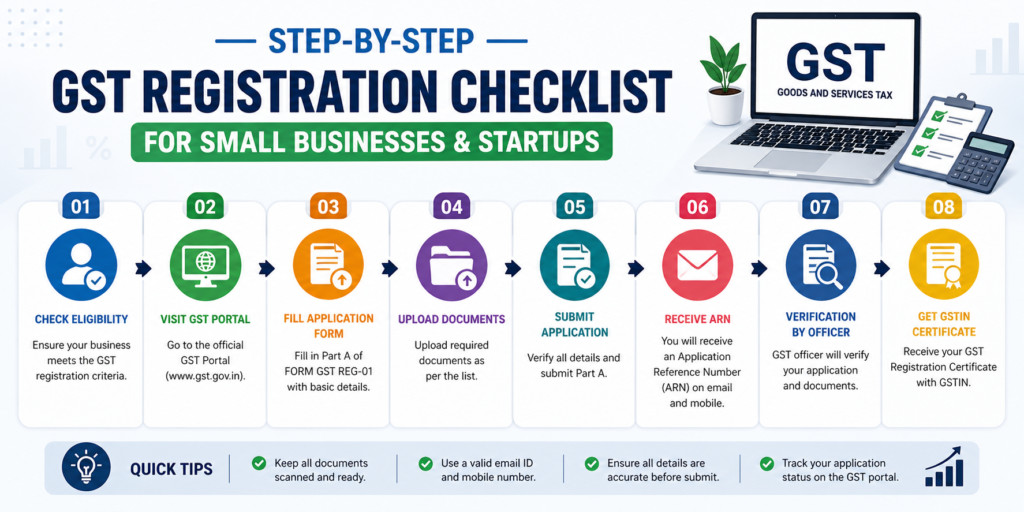
Step-by-Step GST Registration Process Checklist
There are several steps in the GST registration process that a business must adhere to to achieve success.
Step 1: Access the GST Portal
Start the process of gst registration on the website and choose the option of new registration.
Step 2: Fill Basic Details
Fill in your important data, like your PAN number, email ID, and phone number, which will later be used for verification purposes.
Step 3: Complete Application Form
Provide all relevant information regarding the business, its promoters, location, and nature of activity.
Step 4: Upload Documents
All the required documents must be uploaded in the required format, and these should be readable as well.
Step 5: Verify and Submit
Verification of your application must be done through Digital Signature Certificate (DSC) or Electronic Verification Code (EVC).
Step 6: Track Application Status
The application status needs to be checked from time to time to ensure that no delay occurs due to queries raised by the concerned authorities.
Common Mistakes to Avoid During GST Registration
Filing incorrect information in the application form is a typical error when registering for GST. Incorrect PAN, company name, or contact number can result in your application being rejected or delayed.
Mismatched documents are another frequent error in GST registration. When the information in the uploaded documents is inconsistent with the application information, the process of validation becomes difficult.
GST registration errors include mistakes made while filling out the application form, such as choosing an incorrect category for your business.
A delayed response to the verification questions posed by the authorities may also result in your application being denied or having the processing period stretched out further.
By avoiding these common errors, you will be able to have an easier registration process.
Tips for a Smooth GST Registration Process
- A well-defined approach is sure to make the GST registration process hassle-free and mistake-free for the company.
- Always cross-check the information before uploading to minimize mistakes.
- Organize all the necessary documents and keep them handy for immediate uploading.
- Make sure that the uploaded documents are genuine and in the right format.
- Include the correct PAN, Aadhar, and business information to avoid discrepancies.
- Give the right mobile and email IDs for authentication purposes.
- Do a thorough review of the GST registration application before submitting it.
- Address any questions from the tax department without delay.
- Monitor the progress of your application on a regular basis.
- Consider getting help from professionals if needed to avoid complications.
Conclusion
The GST registration process is extremely important for small-scale businesses as well as start-ups wanting to run their businesses under a formalized and regulated taxation system. Not only does the process legalize your business, but it also allows you to manage your tax responsibilities without any complications, along with keeping a record of all financial dealings. The best way to go about the entire process would be by adhering to a step-by-step checklist in order to avoid errors.
Being prepared for GST registration is extremely important. It involves getting your paperwork right and providing accurate information, as well as responding effectively to any verification inquiries. With the assistance of Vakilsearch, businesses can handle these requirements more efficiently. GST registration not only improves your standing as a business but also helps you manage things smoothly in the long-run, allowing you to expand your business and take on more responsibilities financially.