






The 8th Pay Commission salary hike is among the hottest talking points for central government employees, pensioners and job aspirants across India. Each Pay Commission introduces new changes in salary, pension and other key allowances and benefits. After the implementation of the 7th Pay Commission in 2016, employees have been waiting for another revision. Inflation and the high cost of living are expected to increase; alterations in these economic conditions can lead to unrest.
Lakhs of employees and pensioners are likely to get a revision in pay scales by the 8th Pay Commission. While the new structure has yet to be formally announced, estimates show an average salary increase of up to 35 per cent owing to fitment factor and revamped pay matrix. In this article, you will get the latest update on the possible 8th Pay Commission salary hike, expected implementation date, modified pay levels for employees and how much each category of staff is likely to earn.
What is the 8th Pay Commission?
A Pay Commission is a panel constituted by the government to monitor and recommend revisions in the salaries of central government employees and pensioners, also known as the pay scales. Normally, a new Pay Commission is established every ten years. The old system of grade pay in the 7th Pay Commission was replaced by the pay matrix, and the minimum pay was raised from ₹7000 to ₹18000.
The 8th Pay Commission is likely to carry that forward and revise salary structures in line with the new economic realities. It could also reassess pensions, allowances and benefits dependent on service. While a commission has not been formally constituted, reports indicate that discussions and consultations have begun.
Also Read: MTS Full Form | Salary of President of India
Predicted 8th Pay Commission Salary Hike
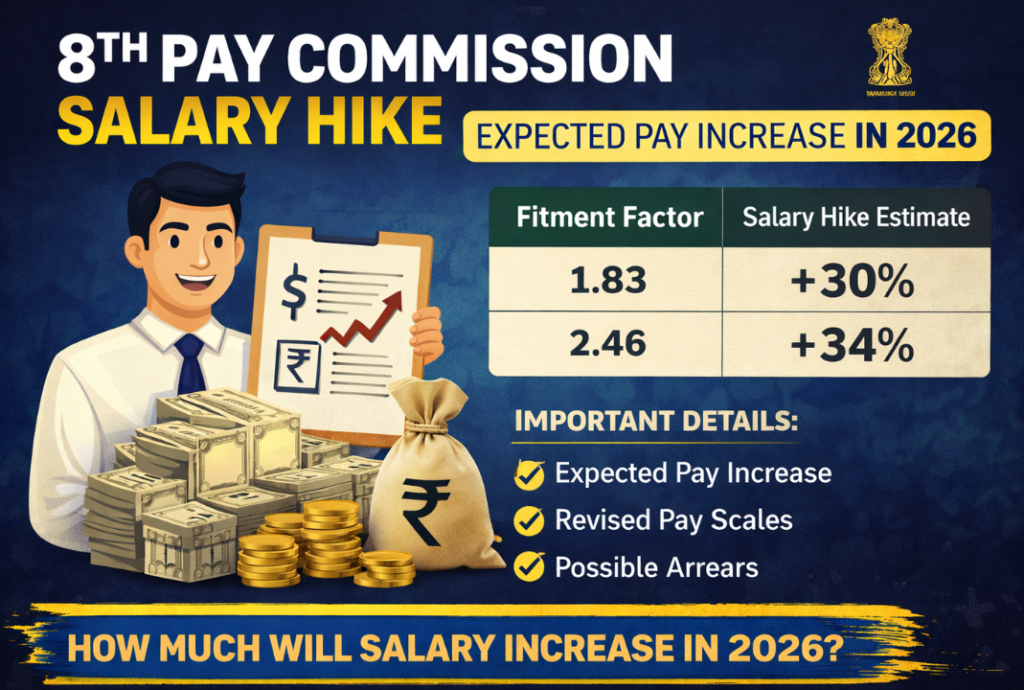
The most fundamental question employees have is how much salary increase they could expect. According to expert estimates and past trends, the 8th pay commission salary hike for central government employees will vary between 30% to 34%, depending on the final fitment factor.
For example:
- Current basic salary of ₹18000. Now it will become approximately 32940 to 44280
- As per the minimum wage, a basic salary of ₹ 25,500 as of now would increase to between ₹ 46,665 and ₹ 62,850
- A basic salary of ₹50,000 now may become ₹91,500 to ₹1.23 lakh
These are the third estimates, and final salaries will be subject to official approval.
Expected Salary Hike Range
| Current Basic Pay | Lower Estimate | Higher Estimate |
| ₹18,000 | ₹32,940 | ₹44,280 |
| ₹25,500 | ₹46,665 | ₹62,850 |
| ₹35,400 | ₹64,872 | ₹87,084 |
| ₹50,000 | ₹91,500 | ₹1,23,000 |
What Is Fitment Factor?
Fitment factor is the multiplying factor to convert existing basic pay into the new salary under the Pay Commission. This is also one of the most basic factors that directly impacts the final pay.
The fitment factor was 2.57 for the 7th Pay Commission. Within the range, reports speculating over a figure between 1.83 and 2.46 for the 8th Pay Commission, while employee unions had sought higher numbers.
Fitment factor or salary hike, like every other KPI, is followed very closely by employees; the higher the fitment factor, the smaller the jump in compensation.
Expected Implementation Date
As for the implementation date, a lot of hope has been associated with the 8th Pay Commission by many employees, and they are also hopeful that if it is implemented from January 1, 2026, then this will help in drawing a comparison, as the 7th Pay Commission started in January 2016. However, nothing is yet set in stone.
When the implementation happens post the due date, say employees will get arrears for those months. However, that wad of backpay may trigger other issues too once the new structure is approved by management.
Effects of 8th Pay Commission on Take-Home Salary
The most important factor behind this action of employees following the 8th Pay Commission salary hike has been its influence on monthly take-home pay. If the basic salary increases, then a host of elements attached to it, like House Rent Allowance (HRA) and travel benefits as well as retirement contributions, will also go up. It indicates the total monthly increase can be over and above the basic pay revision.
HRA is usually given as a percentage of basic salary; metro city employees may be especially favoured. This could mean better monthly pay and savings over the long haul under a new structure of remuneration.
Minimum Basic Salary (Expected Increase)
₹18,000 per month is the minimum basic salary currently allowed under the 7th Pay Commission. The cost of living has gone up considerably since 2016; employee groups believe this should be lifted.
Once the final fitment factor and pay formula are settled, they too will have a minimum salary of ₹30,000-₹40,000. While some union officials have speculated on higher numbers, this amount was never confirmed.
The minimum pay revision will also be among the most monitored outcomes of the commission.
Ways Employee Levels May Differ
The 8th Pay Commission salary hike is unlikely to be uniform across all employees. The increase in salary usually depends on current pay level, grade, years of service and department.
A higher minimum wage floor can do the most good for entry-level employees. Higher absolute increases may be enjoyed by mid/senior employees, as current basic pay is already higher. Pensioners could also benefit from revised pension formulas and arrears.
This is how the final pay matrix will be essential for salary calculation.
How Inflation Comes into Play for the 8th Pay Commission
One of the main reasons that makes a requirement for a new Pay Commission arises is Inflation. Housing, food, transport, education and healthcare costs have skyrocketed since 2016.
Dearness Allowance (DA) adjusts to inflation but is not sufficient over the long run. Doubling this salary revision restores purchasing power and protects employees’ and pensioners’ financial security.
This is why many experts advocated a strong link between the 8th Pay Commission salary hike and the current price situation.
Will Allowances Also Increase?
Apart from salary, employees are concerned about changed allowances. Earlier commissions also looked into pay scales along with components like HRA, transport allowance, child education allowance and special duty benefits.
And if the same formula is applied again, the wage increase would be a general one that involves all workers and is not limited to an increase in basic pay. Restated allowances can be game-changing in a month-to-month earning payout for staff living in exorbitant urban communities or out-of-the-way areas.
DA To Be Merged with Basic Pay or Not?
It is said that Dearness Allowance (DA) may be combined with the basic pay under the 8th Pay Commission itself. But there is no official proposal that can confirm this yet.
Hopefully, you already know that when a new Pay Commission is implemented, the DA becomes zero and the salary goes back to basic pay again.
7th vs 8th Pay Commission Snapshot
| Feature | 7th Pay Commission | Expected 8th Pay Commission |
| Effective Cycle | 2016 | Likely 2026 |
| Minimum Basic Pay | ₹18,000 | Higher than ₹18,000 |
| Fitment Factor | 2.57 | 1.83 to 2.46 (projected) |
| DA Status | Revised twice yearly | May reset after implementation |
| Salary Hike | Major revision | 30% to 34% estimated |
How Pensioners May Benefit
The 8th Pay Commission salary hike talk is equally important for pensioners. Pension systems generally get updated when salary plans are revised.
Final recommendation may lead to pension upwards, modulated formulae and due arrears for retired employees. So this commission is not just about the current staff but also lakhs of pensioners throughout India.
Will State Government Employees Also Be Benefited
While recommendations of the Pay Commission apply directly to central government employees, many state governments eventually follow suit.
It means state employees might eventually benefit too, based on their state’s economic outlook and decisions about policy.
Possible Arrears After Implementation
Arrears might be one of the biggest perks if the commission comes after its proposed effective date. If the new salary is lower than the previous one received, employees may receive lump-sum payments equivalent to the differences in old and revised salaries for complete months.
Arrears will depend on:
- Final fitment factor
- Pay level
- Effective date
- Allowances included in the revision
Also Read: 2 LPA In Hand Salary | 20 Lakh Per Annum in Month
Why Accurate Expectations Matter
A lot of unofficial sources and viral posts say large increases are happening, but employees should hold off before rushing for formal recommendations. The real scenario of 8th Pay Commission salary hike for central government employees will be determined by approval from the government, economic conditions and the actual time of implementation.
Instead of rumours, one can rely on trusted updates and plan finances as per the information shared by these updates only.
Reasons Behind Employee Demands
| Factor | Impact |
| Inflation | Lower purchasing power |
| Housing Costs | Higher rent and EMI burden |
| Education Costs | Rising family expenses |
| Healthcare Costs | Higher treatment costs |
| Long Gap Since 2016 | Need for revision |
Conclusion
The 8th Pay Commission salary hike will be ‘realistic’ and will meaningfully relieve the financial burden for central government employees and pensioners. This means the hike may be between 30 per cent and 34% (depending upon the fitment factor and modified pay matrix) as per the current projections.
Final numbers are still awaited, but the commission can lead to a boost in take-home salary, pensions and the overall benefits. Figures reported here should be taken as estimates until official announcements are made by employees. When introduced, the 8th Pay Commission could be one of the major salary reforms in this decade.
Frequently Asked Questions (FAQs)
Q1) What is the Expected 8th Pay Commission Salary Hike?
Projected salary increases may be between 30% and 34%.
Q2) By what time will the 8th Pay Commission be paid?
Official word on when that will happen isn’t yet in, but many figure around 2026.
Q3) What is the anticipated fitment factor?
Sure, projected estimates come in at 1.83-2.46
Q4) Will pensioners benefit too?
Yes, pension revisions are normally included along with Pay Commission changes.
Q5) Will DA merge with basic pay?
As of now, there has been no confirmation about the DA merger.